Showing posts with label Pamela Rabe. Show all posts

13 February 2015

Review: Jumpy

Jumpy
Melbourne Theatre Company
5 February 2015
The Sumner
to 14 March
mtc.com.au

Jane Turner and Dylan Watson. Photo by Jeff Busby
At least Jumpy is a play about 50-something women who have sex. There's not that much written about the middle-aged years when women discover a new type of social invisibility, and a time when female actors can disappear until they can play crones and clowns.

Written by UK writer April De Angelis, the MTC season opener is as Aussie as Prince Phillip's knighthood. It begins with Hilary (Jane Turner) despairing as her 15-year-old daughter, Tilly (Brenna Harding), stomps up the stairs of their very lovely house. Hilary knows she's still a feminist but is frustrated because 50 seems to offer more loss than gain. She drinks wine and discusses it all with bff Frances (Marina Prior) – who's still husband looking, still wearing bikinis and now heading to burlesque classes – but there's not so much discussion with husband, Mark (David Tredinnick), as her bedtime offering reading Great Expectations to him. Meanwhile Tilly and her friends are doing it like teenagers, with the expected consequence.

With behaviour and observations as complex and photo-shopped as a Women's Weekly (without the bonus of a recipe to try), I waited for the moment when the veneer of expected was torn away to show the real people and the reality of feeling 30 while seeing an old stranger in the mirror.

I don't like seeing dull middle aged woman on a stage because it scares me that THAT's what I look like to the world. I known people who slip easily into the expected, but I don't know anyone who isn't self aware enough to know if they are living a beige-nude-coloured one-piece bathing costume cliche.

There's plenty of jumping about in the plot but most is so obvious that it may as well not happen. Daughter didn't use birth control; daughter shags older boy, mum feeling unsexy; separated couples go away together. The spoilers are built in.

None of which is made any more compelling on the stage. The early awkward accents – why?  – and conscious blocking relaxed, but the relationships – the frustration, passion and despair – in the subtext of the script were lost in the empty space of the stage. Director Pamela Rabe is an actor who makes empty space and subtext scream louder than the words spoken; as a director, she gets the script on the stage and seems to miss the exploration of what those words are really trying to say.

Which leaves us theatre that's as feisty as an old cat asleep in the sun. But regardless of what grumpy critics say, it will also sell well because of it's well-known cast, Marina's burlesque dance and the easy jokes about teenagers and their parents. And it's the box office from these shows that helps the MTC commission new works. Perhaps the price of every MTC independent NEON show is a Jumpy?

This was on AussieTheatre.com.


21 August 2013

Review: The Cherry Orchard

The Cherry Orchard
Melbourne Theatre Company
15 August 2013
Southbank Theatre, The Sumner
to 25 September
mtc.com.au


So that young hipster Simon Stone has gone and had his wicked way with another work of theatrical literary genius. Hooray! If you're reading all the hoo ha about Adaptors V Playwrights and the snooty comments about the laziness of adapting, stop wasting your reading time and get along to The Cherry Orchard.

The Cherry Orchard is awesome theatre. It's funny (if you didn't know that Chekhov is hilarious,  you've been reading him wrong), it's about us, it's surprising, it's moving and it's almost too easy to sit though its four acts.

Stone hasn't re-translated the text, rather he's re-told the story and told it in a way that's as close to what Chekhov wrote in 1903 as it gets (or as close to my Penguin translation). Structurally it's as-written and the dynamic and rhythm Stone's re-worked language is glorious proof of how much Stone adores Chekhov. There are new bits that are very liberally translated, but it's more like he's making the subtext and subtlety clear: of course young Lopkhin kept Ranevskaya's blood and snot covered hanky, and surely it had to take a bit more than a hug to make Dunyasha break a saucer.

Orchard's the story of a wealthy family losing their land because they didn't want to cut down an orchard for the newly emancipated to holiday at, or, in this case, for the newly cashed-up bogans to build McVillas. It's set in the 1970s, but with a language and tone that's now, so the 70s are seen more as a time of societal change rather than a time-specific analogy – and are much easier to relate to than revolution-cuspy Russia. And the era lets designer Alice Babidge go wild with character-perfect costumes and furniture that everyone who lived through the 70s is regretting not keeping.

And it all takes place in a stark white box where the astro turf may be lush and inviting in its plastic, bindi-free falseness but it's impossible to hide. (Unless, you want to hide from people sitting on the end of rows; but, let's leave the "design and direct from the worst seat in the house" discussion for another time because this show's too good to waste time on quibbles.)

Pamela Rabe is Ranevskaya, the matriarch who knows she's not old enough to be so and who's lost so much that moving on in life isn't an option. If everything else in this show wasn't as beautiful as it is, it would still be worth seeing for Rabe's performance. But to notice her above the rest of the cast is unfair as there's not an out-of-tune or -tone note on the stage.

Stone's style is naturalism turned to 11. Chekhov's director was Stanislavski – the dude who gave us method acting – so there's no surprise in style, but this director turns up the intensity just enough to make us aware of how exquisite each performance is. Each actor brings the complexity and honesty of each character to the stage and lets us see their whole lives in a moment. It's so subtle, but this is the difference between laudable acting and being captivated by the characters and their stories.

I don't care if a work's an adaption or brand new; I want to care about the story I'm seeing, and know that being in the theatre is better than anything else I could be doing. This is the first time I've seen a Chekov on stage and wanted to re-read his work so I can re-see it with such a fresh eye. Isn't isn't that what adaption should do?

(As theatre is expensive to produce, tickets to see The Cherry Orchard cost more than going to a movie, but if price is an issue the MTC have discounts available.)

This was on AussieTheatre.com

20 June 2013

Review: Solomon and Marion

Solomon and Marion
Melbourne Theatre Company
12 June 2013
Arts Centre Melbourne, Fairfax Studio
to 20 July
mtc.com.au


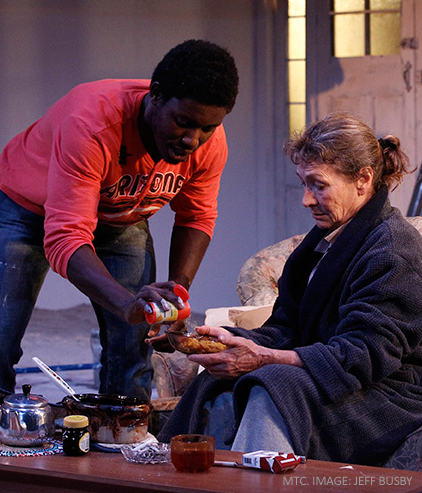
In Cape Town in 2006, actor Brett Goldin and designer Richard Bloom left a party and never got home. They were found naked, except for their socks, near a freeway; they had been robbed and shot through the head.  Goldin was playing Guildenstern in a production of Hamlet  that was about to fly to Stratford to open the Complete Works Festival. Writer Lara Foot worked with the same theatre company and Solomon and Marion is the result of her trying to understand the incomprehensible – and incomprehensibly accepted – violence in her country.

It's a beautiful play. Its uneasy undertone of violence and mistrust creates tension, but it's gentle and loving and finds hope in the endless grief.

Marion (Gillian Jones) is an old white South African who lives alone in the Eastern Cape. She doesn't want to move to Australia to be with her daughter and grandchildren and leaves her door and windows open, despite the constant threat of violence. Solomon (Pacharo Mzembe) is the black grandchild of Marion's former maid and he turns up one day saying that he's been sent to see her.

In a world that's dominated by loss, poverty and guilt, Foot explores two people who cannot escape the violence and are secretly scared of their own complicity.

In a production where design (Richard Roberts, set and costume; Rachel Burke, lighting; David Bridie, music), performance and script work like one, director Pamela Rabe lets this very place-specific story resonate way beyond its South African borders. As its secrets are dug up and assumptions buried in the hilly floor of sand, Marion and Solomon try to understand why the other is in their life, each wanting the other gone, but terrified that they might leave.

But the night belongs to Mzembe and Jones.  I first saw Jones in the early 80s in Jim Sharman's Midsummer Night's Dream; when Mzembe wasn't even born. You don't forget the great actors when you see them, and on TV and stage, Jones is an actor who leaves ego aside and creates characters who live. Mzembe graduated from NIDA in 2007 and lets us see every nuance of Solomon's complex relationship with Marion, which begins with a confused mix of resentment, respect and pity.

This story had its roots in the kind of violence and loss that creates hatred, but it leaves the hate behind to reveal the broken hearts of two people whose have to live with its consequences.

Photo by Jeff Busby

This was on AussieTheatre.com.

01 December 2011

Review: Grey Gardens

Grey Gardens
The Production Company
24 November 2011
The Playhouse, the Arts Centre
to 4 December


The cult fascination with Big and Little Edie Beale doesn't resonate as it does in the US, but it doesn't leave this pair any less fascinating. The Production Company present the Australian premier of the 2007 Tony-winning musical and with Pamela Rabe and Nancye Hayes cast, expectations were high.

The recluse and impoverished Beales were revealed in a 1975 documentary about the mother and daughter living in their filthy East Hampton mansion with raccoons, 50-plus cats, a metre high pile of empty cat food tins and endless fleas. Being the aunt and cousin of Jackie Kennedy-Onassis added to their notoriety and cousin Jackie soon paid for the cleaning of her relatives' house.

The original documentary is still uncomfortably irresistible in its welcomed exploitation, so the decision to re-tell it as a musical could be odd. Why re-tell a story that has already been told perfectly? But such eccentricity and dark sadness must be shared and Grey Gardens creates complexity by including a first act. Set 1941, Act 1 is a fictional afternoon leading up to Little Edie's (Liz Stiles) engagement party to Joe Kennedy (Alex Rathgeber where, cousin Jackie (Ariel Kaplan) runs about, Edie's daddy shows his colours and Big Edie (Rabe) sings and decides her daughter's fate.

For all the genuine affection of Act 1, its ending is played from the beginning, leaving little to draw the audience beyond the veneer of their world.   As it's known that Joe died in WW2, that Jackie nabs his little brother and how the Edie's end up, this act could filled with unfulfilled hope or be so dark that every note is a cruel stab at Act 2.

But it matters little, as Act 2 is what everyone wants to see. Taken directly from the documentary, Big (now Hayes) and Little (now Rabe) are as they will always be remembered. The music is forgettable, but their songs allow the subtext of the documentary to literally sing.

Hayes and Rabe are two of the best around and they surpass all expectations as the Edies bicker and fight for attention and try to find love in their bitterness and regret. It's easy to laugh at the quirks of old-lady eccentricity, but their story isn't easy to laugh with, as it's too close for anyone with parent problems or aging issues or a belief that two cats isn't enough. It's the honesty that Rabe and Hayes find that makes their Edies their own and so much more than remembered images from a tv screen.

With tiny budgets and short rehearsals, The Production Company always create something so much more than expected. Grey Gardens doesn't always grasp the tone and cultural impact of this story, but it's still a great night out and you'll not see better than Hayes and Rabe.

This review originally appeared on AussieTheatre.com

Photo by Jeff Busby

22 August 2010

Review: Do not go gentle...

Do not go gentle…
fortyfivedownstairs
11 August 2010
fortyfivedownstairs
to 29 August
www.fortyfivedownstairs.com


In 2006, Melbourne playwright Patricia Cornelius won the Patrick White Playwrights’ Award and the RE Ross Trust Playwrights award for Do not go gentle… Finally, we get to see a production (thank you fortyfivedownstairs) and the full theatre, longish run and sold out nights are proving that award-winning plays aren’t real until they are produced and shared with an audience.

Cornelius uses the metaphor of Scott’s Antarctic expedition (yep, the one that didn’t end well) to tell the story of six people dealing with the consequences of aging. They trudge through the frozen world and are in a “home”. Some fight their pasts and disappointments at not having fulfilled a single dream, others find happiness and total acceptance, and some struggle with their own brains and memories that won’t let them understand.

Told with delicious humour, Do not go gentle… takes the rage that Dylan Thomas speaks of in his famous poem and makes it palpable. The experienced cast (Paul English, Jan Friedl, Rhys McConnochie, Terry Norris, Anne Phelan, Pamela Rabe and Malcolm Robertson) prove the value of experience and bring a personal element to their characters. Rabe is especially powerful as a woman facing early onset Alzheimer's and Phelan wins every heart as she loses her inhibitions and finally feels loved.

Marg Horwell’s design, Irine Vela's sound and Richard Vabre’s lighting use the vastness of fortyfivedownstairs beautifully, letting the emptiness and the collapsed roof infuse the world with unspoken emotion and gave the script room to fill in the spaces with humour or poignancy. And, under Julian Meyrick’s clear direction, this is the production that Cornelius must have dreamt about.

But for all it’s goodness, I was left as cold as Scott’s team – and I so wanted to warm to it. Cornelius language brings stunning images to the stage, but I felt that the metaphors were overused and that issues were leading the story rather than the characters. With so much time spent telling us about each character’s old-age problem, there was little space to start loving the person. Instead of dispelling myths about age, they almost confirmed the stereotypes they were trying to liberate from assumptions.

But this show is enthralling and talking to its audience, who will happily rage, rage against any dissenting opinions.


This review appears on AussieTheatre.com

13 June 2010

Review: Boston Marriage

Boston Marriage
MTC
4 June 2010
The Arts Centre, Fairfax Studio


"We do love shiny thing," says Anna in Boston Marriage. Yes we do, and this show is shiny and glittery enough to want the necklace and a matching pair of earrings.

David Mamet writes plays and films about blokes and masculinity, so 1999's Boston Marriage was a surprise, being about chintz, chunks and chicks. 'Boston Marriage' was a nineteenth-century endearment for spinsters sharing a house, because they couldn't find themselves a hubby, and the play is a drawing room farce with a wit and passion that (like its namesakes) defies the categories it gets carelessly named.

Mamet's Anna (Pamela Rabe) and Claire (Margaret Mills) have shared more than an abode and Anna can't wait to share the news that she has a wealthy paramour whose generosity will allow them to maintain their chintz-decorated lifestyle. Claire is happy, but more intent on bringing her new (very) young love to the house. If only the youngster didn't recognise Anna's shiny necklace, and the maid (Sara Gleeson) could keep her mouth shut.

From her high camp entrance in lush green velvet, Rabe's insecure and jealous Anna is a perfect foil to Mills's thoughtfully sharp (and desperately horny) Claire. With perfect timing and unbalanced emotion, both have everything at stake and manipulate and insult each other in ways reserved for those we truly love and understand.

Having a divine cast and a script that doesn't waste a single contrived and poetic word must be bliss for a director, and Aidan Fennessy (one of the best comedy directors in town) makes Boston Marriage shine more by camping up the wit without detracting from character or the essential drama of the story.

Gloriously funny and perfectly performed, Boston Marriage plays with class, gender and manners that could place it as easily in today's East Mebourne as nineteenth-century Boston and is by far my favourite MTC show this year.

This review appears on AussieTheatre.com.

16 September 2009

God of Carnage

God of Carnage
Melbourne Theatre Company
15 September 2009
Playhouse, The Arts Centre


God of Carnage holds an IKEA mirror up to the MTC audience and leaves them squirming with recognition and wetting themselves with laughter – or was that just me?

St Martin’s protagonists are in their teens and 20s, Red Stitch’s in their 20s and 30s, Malthouse’s in their 30s and 40s and the Melbourne Theatre Company will always have theatre for people who are surprised when they realise how old they really are.

Two couples meet to resolve a playground incident involving their respective sons, a stick and some dental damage. Naturally, the women wear shoes that cost as much as the dentist bill in question, and espresso and clafoutis are served.

Making fun of the upper-middle class, middle age, marriage, men versus women, and what parents really think of their children is easy. God of Carnage does all of this; however, satire without recognition is as bad as making fun of a deaf kid behind her back – it’s easy, nasty and likely to lose you friends. Playwright Yasmina Reza has an international hit because she ensures that she never makes fun of ‘them’; it’s always ‘us’ and it’s always the stuff we hate to admit!

Reza is France’s best-known playwright who, like Moliere before her, uses farce to show the masks, the absurdity and the humanity of the people who love her work. Structurally it is a blue print for a perfect farce, with ever-changing allegiances, status and opinions, but it’s her grasp of character and her observation of society that is winning this work awards and fans on Broadway, the West End and state-supported theatre companies all over the place.

As it’s difficult to imagine that Reza didn’t write this on a laptop in Church Street, Brighton, much must also be said of the English translation by Christopher Hampton (whose credits include the screenplays for The Quiet American and Atonement), as well as the universality of Raza’s themes.

With a faultless cast (Pamela Rabe, Geoff Morrell, Hugo Weaving and Natasha Herbert), director Peter Evans (who also directed Moliere’s The Hypocrite for the MTC last year) ensures that we are never distanced enough to make fun of these people. It would easy to laugh at this world, but it wouldn’t hurt so much (in the good way) if we didn’t see ourselves, our friends and our families up there.

My inner voice drooled over Annette’s shoes, wondered if I could wear a fringe as well as Veronique, knew I would have taken the clafoutis out of the fridge in time and wanted to offer advice about how to remove vomit from books (I don’t want to explain). I’m far from being a Toorak ‘wealth manager’, but I knew every person, every opinion and every passive and blatant aggressive reaction on that stage.

There’s much written about God of Carnage being an astute reflection about changing attitudes towards violence in society, especially towards children (hands up who hasn’t read The Slap). Of course, there is a serious side to the work, but if that’s what you’re raving about, perhaps you need to glace at the mirror.

This review originally appeared on AussieTheatre.com.

Photo by Earl Carter.