18 October 2019

MIAF: Gender Euphoria

MELBOURNE INTERNATIONAL ARTS FESTIVAL
Gender Euphoria
in association with Arts Centre Melbourne
15 October 2019
The Famous Spiegeltent, Arts Centre Melbourne
to 20 October
www.festival.melbourne


"Gender Eurphoria" Mama Alto. Photo by Alexis Desaulniers-Lea

Press 6.

That's Mama Alto's advice. She gives damn good advice.

When dealing with a robo call during an election, there wasn't an answer that was right for her. When only only option is "1" or "2",  press 6. Binaries only exist in computing.

Welcome to Gender Euphoria. It's a state of mind, a way of being. It's the world we're creating. It's an end to gender dysphoria and a celebration of hope and life.

It's a fuck off to the hate created by fear and to the fear created by hate. It's an end to the ignorance and stupidity that create shame. It's an end to invisibility, hiding and the idea that discomfort is the fault of the uncomfortable person.

It's heartbreak and anger and the relief of over overcoming them.

It's song, burlesque, poetry, comedy, witchcraft, dance, sequins, pride, pride flags, ruffles, flying, supporting, well-cut suits, music and unmitigated joy that shifts the weight of shame.

It's Nevo Zisan's gender whispering to children that they are loved and infecting people with empathy.

Co-created by Mama Alto and director Maude Davey, it was first seen at this year's Midsumma festival, and was, at the time, the largest cast of Trans and gender-diverse performers seen in Australia. This time, the cast is bigger

Along with Mama and Nevo, there's Amao Leota Lu, Miss Bailee Rose, Fury, Harvey Zeilinski, Mahla Bird, Mx Munro, Ned Dixon, Quinn Eades and new special guests Crystal Love, Nikki Viveca and Krishna Istha. And musical director Ned Dixon and bass player Cerise Howard. And Auslan interpreters Mac Gordon and Kirri Dangerfield. And everyone working backstage and in the background.


Embargos mean that its next performances can't be talked about yet, but there are more performances. And I hope that it keeps getting seen at festivals all over the world until audiences wonder why Trans and gender-diverse performers are in a show of their own.


Alexis Desaulniers-Lea is the Gender Euphoria photographer. Photos help people be seen. I'll add more photos next week when they are ready. You've gotta see everyone.

"Gender Eurphoria" Maude Davey, Mama Alto. Photo by Alexis Desaulniers-Lea

"Gender Eurphoria" Harvey Zeilinski . Photo by Alexis Desaulniers-Lea


"Gender Eurphoria" Mahla Bird, Quinn Eades. Photo by Alexis Desaulniers-Lea

"Gender Eurphoria" Nikki Viveca. Photo by Alexis Desaulniers-Lea

"Gender Eurphoria" Crystal Love. Photo by Alexis Desaulniers-Lea

"Gender Eurphoria" Mahla Bird. Photo by Alexis Desaulniers-Lea

"Gender Eurphoria" Mx Munro . Photo by Alexis Desaulniers-Lea


"Gender Eurphoria" Miss Bailee Rose . Photo by Alexis Desaulniers-Lea

"Gender Eurphoria" Cerise Howard . Photo by Alexis Desaulniers-Lea

"Gender Eurphoria" Nevo Zisan . Photo by Alexis Desaulniers-Lea

"Gender Eurphoria" Krishna Istaha . Photo by Alexis Desaulniers-Lea

"Gender Eurphoria" Fury . Photo by Alexis Desaulniers-Lea

"Gender Eurphoria" Amao Leota Lu . Photo by Alexis Desaulniers-Lea


Note: When you slip up and use the wrong pronoun, you apologise because it is YOUR fault, not the fault of the person that you've misgendered. Don't know what pronoun they use? Ask them. And see how easy it is to use a gender-neutral first-person grammatically-correct pronoun in English.

16 October 2019

Review: Yadna's 47th Birthday

Yadna's 47th Birthday
Lessons with Luis
13 October 2019
Fleming Park Community Hall
next show 20 October
Facebook event page


Lessons with Luis. "Yadna's 47th Birthday"

Dear Luis,

Thank you very much for inviting me to Yadna's 47th Birthday party.

The hall looked so good with the decorations and the cakes and chips were yummy; I had a pink cake. I was also really happy that I could wear the badge that you made; it's my most favourite badge because no one else in the world has a badge of a happy meerkat fixing a bicycle.

I'm sorry Luelin wrapped your cat puzzle up as a pass-the-parcel prize; if I see one like it at an op shop, I will buy it for you. I also have a little brother and even as adults, little brothers can be really annoying. But it was really nice when he sang Yadna your mum's favourite song. I think your mum would be very happy knowing that you have a neighbour like Yadna who makes you both lasagne.

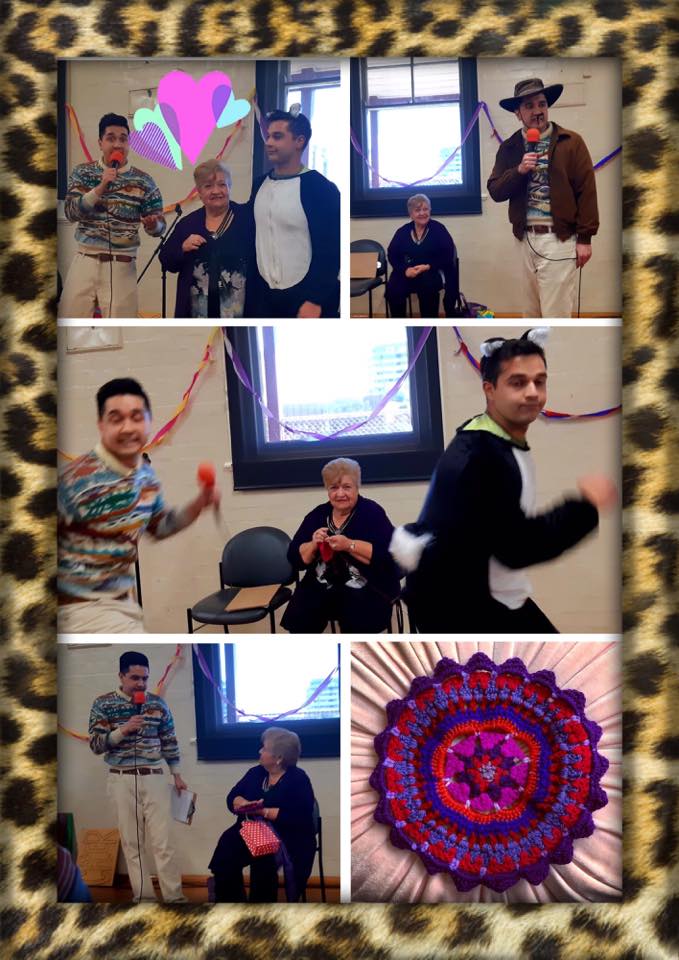
Some photos I took at the party
and Luis's photo of the doily I made Yadna.
(Luis thought it was for catching spiders!)

I'm going to a lot Melbourne International Arts Festival shows this month, so I write about things called the canon (which isn't a glitter canon; glitter canons are far better) and use words like intersectionality, diversity, context, discourse, and immersive experiential theatre that creates community through the unconscious impact of subjective narrative. I also use some swear words, which I know you don't like, when I describe art.

Words to describe you and your super-excellent party are: cool, super-cool, very talented, kind and loving. Love is a very important word, isn't it.

(And immersive experiential theatre that creates community through the unconscious impact of subjective narrative. And in the name of all that's mother-fucking holy, how is there not a Lessons with Luis tv show that will stream all over the world and be seen and loved as much as Nanette?)

I also really like your new song, "Cat Surprise". Not only because it's a good song, but because the lyrics mean a lot to me. I love it when I'm walking down the street and see a surprise cat, especially when the cat wants a pat. I don't have a cat at home any more. This is sad news, but my cat Molly had to go to the rainbow bridge earlier in the year. That means she died. She was just over 19 and a half, which is very very old, so it was time for her to go. (Maybe she has given your mum a surprise visit and they've had a pat together.) I still miss her very much, but she was loved and safe since she was found by my neighbour in a drain as a four-week-old kitten. Loved and safe are very good things. And neighbours who are friends, like Yadna, are also very good things to have in your life.

I know that you and Luelin are giving Yadna a second birthday party – because she deserves two parties – and I hope that lots of people come and bring her presents.

Love from

Anne-Marie

PS. I'm a bit more than 47 and I think Yadna is a little bit older than me, but I won't tell her that.


12 October 2019

MIAF: Grey Rock

MELBOURNE INTERNATIONAL ARTS FESTIVAL
Grey Rock
Remote Theater Project

11 October 2019
Merlyn Theatre
to 12 October
www.festival.melbourne

"Grey Rock". Remote Theater Project

A former TV repairman is building a rocket in a small village in the West Bank in Palestine. The only place big enough to hide its building and launch it a mosque.

A man finds a way to show love and hope to his daughter and the world after the death of his wife.

Grey Rock is a story about living in an occupied land but isn't about occupation. It's a deeply personal and domestic story about connection. In this case, how Yusef (Khalifa Natour) has more computer capacity on his smart phone now than the US team that sent that first rocket to the moon in 1969. So he sets about making a rocket in secret. He's helped by a local man who makes deliveries (Ivan Azazian) and his Iman (Motaz Malhees), as his daughter (Fidaa Zaidan) and her fiancé (Alaa Shehada) try to discover what he's doing. Eventually the world finds out.

The Remote Theater Project was founded by Alexandra Aron in 2018. Based in New York, it commissons artists who are geographically or politically isolated to develop new work and tour internationally.

Grey Rock was written and directed by Amir Nizar Zuabi from Palestine and is performed and created by people from all over the Palestinian territories, except Gaza. Written in English for an American  audience, it was developed in Palestine and first performed in New York at La MaMa Theater in January this year; some of the cast had only performed in Arabic before. It's heading back to the USA after this Melbourne season.

It takes a while to settle into the pace and gentleness of the story – and a lot of its intimacy is lost is the Merlyn – but it sneaks into your heart as its truth becomes clear and its impossibility becomes so believable that it's impossible to not look at the, nearly, full moon when you leave the theatre.

MIAF: The Shadow Whose Prey The Hunter Becomes

MELBOURNE INTERNATIONAL ARTS FESTIVAL
The Shadow Whose Prey The Hunter Becomes
Back to Back Theatre
10 October 2019
Fairfax Studio, Arts Centre Melbourne
to 20 October
www.festival.melbourne

"The Shadow Whose Prey The Hunter Becomes". Back to Back Theatre

Five activists are having a meeting. It's like every meeting anyone has been to in a community space. It's like the meetings the Extinction Rebellion organisers have been having. It's like every work meeting about collecting for charity or organising a staff outing. This one is so low key that there isn't even a tray of biscuits from the supermarket.

Back to Back Theatre are extraordinary.

The Shadow Whose Prey The Hunter Becomes has a short season for the festival and heads to the USA in January. Unlike previous works, there's no holy-wow design, historically/spiritually encompassing themes or unanswerable questions to offer safe distance (Ganesh Versus the Third Reich, Lady Eats Apple).

With only five chairs, a screen showing voice-recognition surtitles, some tape, a ladder and a large foam block, there's no artifice to make assumptions about the script, the company and the performers. It may even be the kind of show that some people expect when they go to show by a company whose members have intellectual disabilities.

And it's nothing like what it looks like.

Michael Chan, Mark Deans, Simon Laherty, Sarah Mainwaring and Scott Price talk about things that they'd like to change in the world and their lives.

They get it wrong and make assumptions. Scott tells Sarah that she needs to be careful of paedophiles; she reminds him that she's a 36-year-old woman. The "Siri"s voice recognition makes mistakes – and there's an argument about if it should even be there. Mark Chan gets Wadawurrung and Wurundjeri mixed up. Mark Deans puts a tape line on the ground that isn't to be crossed. Siri  makes choices.

Most of the cast have been with the company for years. They've created and performed in some of the most internationally acclaimed works ever made in Australia. They are among the handful of permanently employed actors in the country. To think that they are just having a conversation about what it's like to have having an intellectual disability is as condescending as some of the things they discuss. To assume they are even talking about their own experiences dismisses the basic conceit of acting.

Director Bruce Galdwin, the cast and other members of the company have been developing this new work for about two and a half years. It's changed a lot during that time.

Somewhere towards the end of the night, the cast ask each other if "they" – the other people in meeting who are smiling politely and laughing when they think they should – get it. They know that "they don't get it". I didn't get it until then; I made many assumptions and want to see it again to try to see everything I didn't get.

The Shadow Whose Prey The Hunter Becomes is unexpected and may only make complete sense in the context of Back to Back's years of work – which makes it even more extraordinary as a stand alone piece.

10 October 2019

MIAF: A Brimful of Asha

MELBOURNE INTERNATIONAL ARTS FESTIVAL
A Brimful of Asha

Why Not Theatre
9 October 2019
Beckett Theatre
to 13 October
www.festival.melbourne

Ravi and Asha Jain. "Brimful of Asha"

If I had a mother like Asha, and a family like the Jains, I'd probably be married. I'd probably be at the finding partners for my children stage. And I'd be able to make damn good samosas. Maybe Asha is right?

Ravi Jain was born in Canada and his parents are from India; he explains that he's Canadian and they are Indian. In his late 20s, after he'd studied and travelled and was forming his own theatre company, his parents knew that it was time for him to get married; after all, he was 27! A Brimful of Asha is Ravi and his mum, Asha, telling the story of how his family tried to introduce him to a suitable wife.

Ravi is a theatre maker; Asha doesn't really like theatre, but she's determined to convince Ravi and the audience that she did the right thing. He's determined to convince Asha that meeting someone you like and getting married when and if you want to is the right thing.

Asha and Ravi meet the audience as they come in and offer a samosa, made by Asha. Sitting at a family table with a pot of tea, they tell the story about how Ravi's parents and family did their best to arrange a marriage for him; after all, it worked for their generation. The Jains are clearly a very happy and loving family. How many people would perform a show with their mum and tour the world?*

The show began when Ravi told his mum how his friends love hearing the stories of the arrangements and that he wanted to make a theatre show out of it. She wanted to make sure that her side was heard. She'd never been on stage, and doesn't really get what her son does, but they started telling the story to audiences and began writing.

At times, the arrangement experience is still excruciatingly embarrassing for Ravi and hilarious for anyone who wasn't in that same situation, bu this story never demeans or dismisses his parents and their beliefs. Even if Asha weren't on stage telling her story, Ravi wouldn't think of humiliating his parents.  And lots of people tell Asha that she's right.

Ravi also gets the opportunity to ask his mum if she followed her dreams, despite her happiness and family.

It's ultimately a story about love and family and all the ways love is shown in families. There's a lot of joy and, but, as Asha says, fighting with her husband is also one of the best things about being married.

Telling our stories creates community and breaks down barriers that never really existed in the first place. Being welcomed into this story is delightful.

* There's also Hannah and Angela Norris in After You.


The Norman Cook (Fatboy Slim) remix.


09 October 2019

MIAF: Wonders

MELBOURNE INTERNATIONAL ARTS FESTIVAL
Wonders
5 October 2019
The Famous Spiegeltent, Arts Centre Melbourne
to 20 October
www.festival.melbourne

Scott Silven. "Wonders"

If you know how it's done, what's the point? You can look into the shadows behind the stage, watch Scott Silven's hands and refuse to shut your eyes when he asks you to – and you will be left even more amazed at Wonders.

Magic? Mind reading? Trick? Mass hypnosis? Silven calls himself a mentalist and an illusionist. He never pretends that he's magic. He's soap-opera-lead good looking with dark hair that's a just-right cut of either too short or too long and a dark suit that could be hiding all sorts of tricks.

The Famous Spiegeltent's velvet, wood panels, mirrors, coloured glass and ghosts of thousands of performances heightens the mood of the simple stage with quaint olde worlde props and smokey lights.

He's charming in a way that lets everyone think they could be his friend. He wouldn't offend at any dinner party and the sort of person who you wouldn't hate if you were stuck next to him on a long-haul flight. As he talks of reading and escaping to his grandmother's attic as a child and playing with her necklace as he counted the seconds to darkness, he's every child that felt they were different; it's so easy to trust him and his stories.

And we do.

We know he's not reading our minds, but it's wonderful to think that he his. His skill is faultless. He makes accurate predictions, guesses words that people are thinking, and produces drawings and ideas and thoughts that are for more than misdirection and sleight of hand.

It's wonderful. His narrative is minimal, but he talks about re-igniting a sense of wonder and community. His wonder starts with nostalgia, empathy and recognition. This creates joy and comfort. And it's wonderful to be in a room that's so full of joy.

I don't want to know the tricks.


06 October 2019

MIAF: Colossus

MELBOURNE INTERNATIONAL ARTS FESTIVAL
Colossus
Stephanie Lake Company
5 October 2019
Fairfax Studio, Arts Centre Melbourne
to 6 October
www.festival.melbournek

"Colossus". Stephanie Lake Company

Colossus was given the competitive Arts Centre Melbourne and Melbourne Fringe Take Over commission for 2018. This gives the company the resources, support and previously almost-unheard-of opportunity to take over the Fairfax Studio area and create a new work. It also makes connections with the most independent of theatre festivals and the venue at the peak of arts in our city. The Melbourne Fringe season of Colossus sold out and was regularly talked about as an unforgettable show of 2018.

MIAF director Jonathan Holloway said at a media briefing that the only way he could see this show that so many people were talking about was to book it for the festival. It sold out again.

Melbourne-based choreographer Stephanie Lake formed her own company in 2014. She became known in Melbourne for her work with Chunky Move and Lucy Guerin Inc and has worked with many Australian and international companies and had work in international festivals.

Colossus is a work that couldn't have been made without the the support of a bigger organisation. There are 50 dancers in black on a stage that is a bit bigger than size of 50 dancers lying arm to arm, feet to the centre, in a circle. They are young and emerging dancers and are performing in an international festival.

Working with so many dancers is rare; I can't think of a contemporary company that is able to create with so many people.

For all of this alone, the work is so unique that you can regret not getting a ticket.

The bonus is that it's exquisite and impossible to look away. It begins in stillness, in that circle of dancers, and one movement creates momentum and energy that comes in waves that gently lap and tsunami and breaks apart and joins together until it eventually collapses. It's like a physics lesson as movement from one dancer creates movement in the next, and individuals swarm in masses or and break away for a moment before return is inevitable. No one is more important. No one is not important. The community are as much the art as its creators.

The community is also Robin Fox's composition that is almost inseparable from the movement as it follows and leads when it needs to, and Bosco Shar's lighting that creates a world that interacts with the dancers interacting with each other. It's stunning. The floor and walls are white. Sometimes shadows are created by light, but there are bodies between the source and the wall and at times it looks like there are shadows of shadows as height and depth and shades of grey change and move as the join and cross and fade.

It's so difficult to create work with a large cast, but Colossus has been seen twice now – and that's not enough.


05 October 2019

MIAF: Anthem

MELBOURNE INTERNATIONAL ARTS FESTIVAL
Anthem

3 October 2019
Playhouse, Arts Centre Melbourne
to 6 October
www.festival.melbourne

"Anthem". Photo by Pia Johnson

Anthem
is the 20-year follow up to the much celebrated 1988 production of the Melbourne Workers Theatre's Who's Afraid of the Working Class. I didn't see it. I wasn't living in Melbourne and somehow even missed the tour. When I moved to Melbourne, I saw some of the MWT's last productions but still regret missing Who's Afraid. And I miss an arts political culture that supported a company called the Melbourne Workers Theatre (1987–2007). Sometimes we don't realise how important some voices are until they are gone – even if it's nice to not hear so much of Kennett.

The Who's Afraid writers were Andrew Bovell, Patricia Cornelius, Melissa Reeves and Christos Tsiolkas, who have since individually made significant impacts on our theatre and other writing. Each have also written at least one thing that I've loved so much – SO much – that I've asked myself why I haven't loved all of their work.

To see them all writing new work for a main stage in an international arts festival is something to cheer about. Thank you Arts Centre Melbourne.

To re-visit independent theatre 20 years after it was first made, find a way to get the gang back together – including director Susie Dee, who conceived the idea of original work, and composer Irine Vela –, and to offer enough financial support to cast, create and stage a follow up is so positive and exciting that it offers hope in a bleak arts scene. Let's hope it also leads to re-staging some of those Cornelius, Reeves and Bovell plays that only got one run; Tsiolkas is already read by a lot of people.

On a simple level, Anthem asks what we sing about today; hands up if you know your AFL team's song and mumble the words to Australia's national anthem. Like the first play, the four wrote an individual story and these stories are interwoven into a bigger story about the issues that face our city, and world, today.

Their common ground is trains. Trains are a social equalisers in Melbourne with most lines beginning in very far out suburbs and passing through some of our wealthiest suburbs.

"Anthem". Photo by Pia Johnson

Marg Horwell's striking design creates the mood. Her designs consistently get into the heads of the writers and bring their worlds to a visual life that I doubt any writer could imagine until they saw it. It looks like an underground station that reminds me of the old Spencer Street station. But they could be anywhere with functional concrete walls, stairs to the places we don't see and benches that are moved and reconfigured to create the feel of crowded trains while giving the stories as much emotional space as they need.

With a consistently remarkable cast of 14 – bloody Nora, they are good –, Vela's score played live and building the emotional complexity, and Dee's direction that never lets go of the big picture, it's easy to see it as one work, even if the writing voices are different.

Bovell's chorus of commuters makes the ritual of public transport feel mythic and his story of a Myki ticket confrontation leaves it impossible to chose whose side you're on. Cornelius brings the still-too-rare sight of middle aged and ageing women onto the stage. These women should be at the best time of their lives and yet have no way to even imagine a safe, let alone a comfortable, future. Reeve's story of exploitation and unpaid wages becomes a love story that finds joy even when everything else is pretty horrible. And Tsiolkas's continues to create Melbourne characters who are so recognisable that I don't want to see him write a middle-aged arts writer still struggling to rent in the Bayside area.

There's empathy, anger and frustration in these stories but it's hard to know who this show is talking to and what we are laughing at when it's easier to laugh than to despair. We happily cheer a woman singing for coins on a fictional train, but did any of us give $1 to the young woman begging for change on Princes Bridge when we walked back to Flinders Street station to get a train home?

And I didn't even do that; I drove because the Frankston line only runs a twice an hour after 10.00, which correlates to who catches the trains at night (end of the line suburbs) compared to those who catch it during the day (close to the city suburbs). Try relying on trains if you don't have a car, live way beyond the tram zone and don't have an Uber account because you don't have a credit card. Public transport might be an equaliser if it really served the people who need it.

And try talking about class, race and equity during a capital-A Arts festival.

Anthem is a passionate reflection of a city that struggles with its own inequity, even as it sings along to that Courtney Barnett song about having to move to Preston. But there's a degree of political and social writersplaining that takes away from its authenticity; you has me at Northcunt and lost me at nihilism.

These are stories about people who face so many of the barriers explored in this work that they may never see themselves on the stage.

And perhaps that's the point.

Having a large cast means that there are always observers to each story. And while we're following stories, it's being with the observers that create the moments when Anthem spits on our assumptions and forces us to be on the train wondering what we would do if it were us. Or what we didn't do the time it was us. Or when we complained that a train was delayed...

The biggest hope is that this isn't the only production of Anthem. Like its inspiration, it's a work that needs to develop and be seen far wider than a festival audience.

30 September 2019

Melbourne Fringe: The good news stories

MELBOURNE FRINGE
12–29 September 2019
melbournefringe.com.au


So Melbourne Fringe is over and we have a couple nights off before Melbourne Festival begins. I saw a lot of shows – I think 31, but it's a blurr – and missed that many again that I wanted to see.

So many people don't see, go to or cover Fringe because of the big curated Festival – and they miss out on so much. Melbourne Fringe is the event where we see the beginnings of works that go on to change how we make theatre. It's where we see stuff that will never be seen again. It's where you will see an artist who connects with you and you and know that you are going to see everything they do. It's where arts community and audiences are developed and built, and where no one gives a toss what the sponsors think.

These are some of the many good news stories this Fringe.

Danny Delahunty and his team creating a new Fringe Hub at Trades Hall. So many more venues. A place full of history that reminds us every moment that the word "union" means working together.

Indie media stepping up again. There was the ARTery podcast - EVERY DAY, thanks to Jason Cavanagh and host extraordinaire May Jasper. Myron My at My Melbourne Arts saw 61 shows! And wrote about them. The only way to get the context, depth and importance of this event is to see a lot.

Awards. Yep, sometimes awards they are guff, but a lot of Fringe prizes are support to get to other festivals, and the "best" ones are decided by panels of industry people who also see so many shows throughout the festival. It's one to be genuinely chuffed about.

Ones that made me smile.

Andi Snelling's Happy-Go-Wrong is off to the Adelaide fringe.  (I talked about this on ARTery podcast.)

Andi Snelling.  Happy-Go-Wrong

Bron Batten's Waterloo is off to North Melbourne and to Edinburgh. I can't wait to see what this show becomes. This means that I somehow have to get to Edinburgh next year. As an arts writer, if I saved everything I earned as an arts writer in a year, I couldn't even get a flight. And that's more than others get.

Oh No, Satan Stole My Pineal Gland directed by Jean Tong and Louisa Wall won Best Ensemble. They were.

Claire Rankine won a producing award for Polygamy, Polygayu, which she also directed  and it was developed and performed by Alice Tovey, Charity Werk, Margot Tanjutco and Hayley Tantau.

Alice Tovey, Margot Tanjutco, Charity Werk, Polygamy, Polygayou. Photo by Ling Duong

Bryony Kimmings won Best Theatre for I'm a Phoenix, Bitch (ARTery podcast). She's still one of my favourite artists and even if I wasn't 100% sure about this work, its impact is astonishing. I've spoken to people who say their lives have changed since they saw it. Produced by Daniel Clarke and Arts Centre Melbourne.

Selina Jenkins's BOOBS won Best Cabaret. It's one of the best shows I've seen this year (ARTery podcast).

My favourite story is the two clowns from LA, Amritha Kaur Gemma Soldati, who came to Melbourne and knew no one and won Best Comedy. I saw The Living Room because someone from The Butterfly Club told me about it. (Those networks of people really do work.) It only ran for a week and us who saw it now have some pretty good bragging rights. If you missed it – well, I told you it was good.

Frobert and Joshua Ladgrove. Pic nicked off Facebook.

My nearly-favourite story isn't a prize (but this show won the Golden Gibbo at MICF). Joshua Ladgrove Presents Melbourne’s Only Bilge Pump Sales Seminar sold out – in the good way, the every seat filled way. Add an extra star to my comedy festival review. Three years ago, he did a Fringe show with an audience of nine: we will always be the Portenza Nine.

There many other artists and shows that I could mention – and hopefully did on Twitter – , but a lot of them are going to get lots of words in the future. And I many never have known about them if I hadn't seen them in this festival.

Review: Oh No! Satan Stole My Pineal Gland!

MEBOURNE FRINGE
Oh No! Satan Stole My Pineal Gland!

21 September 2019
Fringe Hub: Trades Hall - New Council Chambers
To 29 September
melbournefringe.com.au

Oh No! Satan Stole My Pineal Gland

My review is in Time Out


25 September 2019

Review: Waterloo

MELBOURNE FRINGE
Waterloo
Bron Batten
Brunswick Mechanics Institute - Theatre
to 25 September
melbournefringe.com.au

Bron Batten. "Waterloo" Photo by Theresa Harrison

My review is in Time Out.

And this interview is great for background.

PS. Gary Abrahams was the outside eye for this show and directed the first Onstage Dating.

21 September 2019

Review: The Living Room

MELBOURNE FRINGE
The Living Room
Amrita Dhaliwal and Gemma Soldati
17 September 2019
The Butterfly Club, upstairs
To 22 September
melbournefringe.com.au


Amrita Dhaliwal and Gemma Soldati. "The Living Room"

My review in in Time Out.

(I loved it.)

Interview: Bron Batten background for Waterloo

MELBOURNE FRINGE
Waterloo
Bron Batten
Brunswick Mechanics Institute - Theatre
to 25 September
melbournefringe.com.au

Bron Batten

This isn't a review of Bron Batten's Melbourne Fringe show Waterloo. One is coming. Update: it's here.

It's an interview I did with her in March about her show Onstage Dating. She talks about her "next show" in this interview. Waterloo is the next show.

It was originally published on ArtsHub.  (Give it a read there as well.)

Bron Batten. "Onstage Dating". Photo by Theresa Harrison

I find a hidden Melbourne bar with Google Maps. It’s empty in the mid-afternoon, but there are booths for snuggling, small tables for hand holding and a balcony with flattering natural light. “Are you meeting someone?” the bartender asks as I’m looking at my phone messages. “Yes”. I hope he thinks I'm on a nothing-better-to-do-this-afternoon Tinder date.

I’m not. I’m meeting performance artist Bron Batten, who buys me a beer anyway.

Her show Onstage Dating is playing at The Butterfly Club during the Melbourne International Comedy Festival. We meet at a bar where she’s gone on dates. It’s a great choice. Above the main city street, it’s easy to forget the tourists and takeaway food below – especially as the trams ding-ding and the pale green plane trees give shade and, for once, hold tight to their balls of hay fever fluff.

“Let’s talk about dating,” I start.

She sighs, “What do you want to know?” I know that sigh. It’s the sigh of a 30-something who’s been on a lot of dates.

Batten’s been on 85 onstage dates at festivals and theatres in Australia, New Zealand and the UK. She developed this show when she was granted the Australia Council Cite Des Arts Internationale residency in Paris in 2015. “All that bread, wine and cheese – I had such a terrible time,” she says.

She also went on “about 60” in-real-life dates in Paris; all internet procured. I ask if it was just research. “It was always two birds, one stone,” she says. “I’d never really dated before. I’d always just met people through friends or at the end of the night at the pub.”

The resulting show premiered at the 2016 Festival of Live Art in Melbourne. Batten’s known for work that finds a delightfully awkward and super-smart balance between reality and performance art. She was a founder of The Last Tuesday Society – a much-missed monthly subversive bo-ho performance-comedy-cum-cabaret night – where I remember her singing “Red Headed Woman” naked after Julia Gillard was ousted as prime minister and choreographing a jazz ballet nativity play. She began to get more attention with a show called Sweet Child of Mine, which she performed with her father. It started by asking her country-town parents (she’s one of six siblings) if they really understood why she danced a chicken abortion in an empty swimming pool at university.

In Onstage Dating, her co-performer is a date chosen from the audience. She describes it as “a romantic comedy with weird performance art bits.”

Bron Batten and date. "Onstage Dating". Photo by Theresa Harrison

I saw her first date/show and it’s that and more. It’s every hope and fear you have while dating with the bonus of connecting with other people who make that same dating sigh. Or laugh. Or eye roll. And there’s a sexy bee suit and an apple.

She explains that “it’s not just about online dating. It’s about the vulnerability of meeting someone for the first time. Or the vulnerability to say, I want romance or sex or partnership or companionship … I wanted to capture the expectations and stress of meeting a stranger for a date.”

It’s also about becoming invested in the date. Even knowing that their romance is almost certain not to happen, audiences want the date to go well. We want a happy ending. At least I do.

Batten rolls her eyes when I tell her that I still want to watch a stranger fall for her on stage.

She then tells me she’s been on two second dates following shows.

Neither resulted in a third date.

I can understand if she’s getting cynical about it all until I ask what struck her the most about going on those 60 IRL dates. She says, “hopefulness”.

Theatrically the show captures the hope and vulnerability of showing up and not knowing what to expect. “I don't know what they're going to be like. Are they going to be nice to me? Are they going to be a dick? Are they going to be sweet? What's going to happen? So that feeling that happens in real life is still in the show and the audience recognises that.”

She also has a story about meeting someone on those IRL dates but “that’s the next show”.

Bron Batten and date. "Onstage Dating". Photo by Theresa Harrison

On stage, she’s dated straight, queer, single and partnered men and women, but she thinks that it’s become more about how men behave with women than about the vulnerability of dating.

Her audiences are often mostly women and “there’s a sense of recognition when we share the bad behaviour.” But “it’s not a show that accuses men. It gives them space to be better. It’s just really disappointing when they fuck that up.”

She tells the story of one who fucked up.

“He was very tall, a Disney-prince-type dude with a blue linen shirt, beige pants and boat shoes with no socks – you know that guy. Really tall. Not terribly smart. He came with a whole bunch of friends and I was sort of playing to the friends. I realised that he wasn't very clever, and he sort of clocked that I was making a bit of fun of him. When we were playing Twister [spoiler, her dates play Twister with her], my eyes were at crotch level and he hit me in the face with his cock – on stage. Like a little thrust. Like a little kind of reminder about ‘Hey I’m in charge; know your place’. Like it was it was deliberate smacking me in the face with his dick and I had to make a decision at that point about what to do as a performer and also as a woman.

“Do I call him out? Do I risk turning the audience?

“I am so shocked as well, but I didn't know what to do. So, I let it go. Let’s just get to the end of the show.

“And then, when I took him to the couch and got him to take his shoes off, underneath his oh-so-casual boat shoes he was wearing tiiiiiiiiiiiiiiny little sockets.”

She says the audience snorted with laughter as much as I did at this revelation.

“I was like ‘What are those Michael?’ And I was like ‘I’ve got you, I’ve fucking got you’.

“I did a couple of minutes on his socks. ‘I’m going to tell stories about you.’ The audience were pissing themselves and then he turned. He got really angry and I thought of that Margaret Atwood quote that women are afraid men will kill them and men are afraid women will laugh at them.

“I ridiculed him publicly and that was the worst thing that I could ever do. To my kind of shame, I spent the rest of the show trying to get him back on board because performatively, you know …”

There have been others who behave badly. Like the one in country NSW who acted like he “didn't want to be anywhere near me and the audience were laughing at that, saying ‘ha ha ha’ isn’t that funny when he acts rudely towards this woman”.

“By the end of that tour, I was like: all the guy has to do to win the show is to be a basic human being. Just be basically humanly decent. To not be a dick. You know the joke about a male feminist who walks into a bar because it was set so low. All you have to do is to be a nice human being and it’s amazing how many times the participant fails.

“That’s when I started to realise that this was about more than dating. It was about men’s behaviour in public on dates, in private taking up space … weather they’re ok being in my space or weather they try and claim it back aggressively or by trying to neg me or by trying to make jokes at my expense or at the show’s expense because they’re uncomfortable.

“For a lot of men that’s a very unfamiliar feeling to be in the space and to not know what’s going on, to not feel in charge of it and to not feel entitled to be the centre of it.”

Maybe I don’t want any of these men to fall in love with her. My fantasy of the wonderful story now as flat as the dregs of my beer.

I ask what she does do in real life when it happens?

“Umm … I don't know.

“I’d like to say like to say that I always call them on it, but I don’t. But I think as I get older I’m getting better at it. Calling out shit behaviour is really hard. It’s the hardest.”

I ask why she thinks we still put up with bad behaviour. I’m older than she is and I still put up with it.

We’ve “got this patriarchal structure that tells us that we're wrong all the time and that we're hysterical or we get what we deserve. The ultimate goal in life is to find a partner, right, so you have to suffer whatever. There is a myriad of answers: societal, structural, personal.

“Because it is hard to value yourself.”

We know why we sigh. So, I ask how many men “win” at the show.

“Between 85 and 90 percent.” A much better hit rate than I expected.

“I want them to win. The show’s not about humiliating, it’s the opposite; I always want to make the guy the hero.” She explains how the audience usually clock very early if “the guy’s a jerk” and they mostly don’t let him get away with it.

“I had a guy in Edinburgh who was a big masculine kind of ‘hey’ type dude. Very basic.” He had 80 people boo him for trying to humiliate her. “He was really shocked … so, I was like ‘Give him a go’ and I said to him, ‘See, in the biz, this is what we call turning the crowd.’ … and he spent the rest of the show trying to make up the ground that he’d lost.”

So even the dud dates can come around.

Bron Batten and date. "Onstage Dating". Photo by Theresa Harrison

As we keep talking about dating and the show, she has more positive than negative stories.
Like the “bloke-y tech” who told her that he’d been thinking about the show and how he and his friends talk about and interact with women.

And the guy who talked very lovingly about his mum on stage without knowing that a friend was recording it. And his mum saw it.

And her receiving “this incredible letter” from a date who said, “I didn’t intend to talk about that on stage, but you made me feel so safe and it’s really shifted something in me and I feel like I’ve let it go so thank you for giving me that opportunity”.

And one of Batten’s friend’s telling her that the show inspired her to date again.

And Batten telling me how she can have an opinion of someone and how quickly it changes. “It only takes 40 minutes for them to open up and say things and be silly and construct this kind of fantasy with me.”

I ask if she’s still dating in real life. She laughs with the sigh this time. “That connection is so rare, and people keep looking for it.”

Which is one reason why Onstage Dating is still popular and touring. We keep looking. The two of us share meeting stories we’ve seen. She has a friend who fell in love with the first person they chatted to online, and one who saw someone in the crowd from the stage. I’d recently been to a wedding of a friend who met his husband on a train on a holiday. It happens. Wonderful stories happen.

I still want it to happen for me. And for Bron. I want to tell the story about seeing two strangers falling in love on stage in a performance art show about dating. Or hear about a couple who went on their first date to this show or went by themselves and started talking to the stranger they sat next to.

“Maybe this time, Anne-Marie. Maybe this time,” says Batten as she gets up to leave.

And we should have left together so that the bartender had a good story to tell about the mid-afternoon Tinder date he watched.