If you're nostalgic about 2007, reviews from that distant year are now uploaded.
It was the year
I discovered iOTA and Lally Katz,
Micky D told us about having colonic irrigation,
Kristy Edmunds presented the most amazing MIAF program
and my favourite play was Air Balloon Across Antarctica.

Mostly Melbourne theatre reviews
Showing posts with label Kristy Edmunds. Show all posts
Showing posts with label Kristy Edmunds. Show all posts
28 February 2010
24 October 2009
Final MIAF 2009 thoughts
MIAF 2009
A Reflection. Nah, it's a rant.

It's the last Saturday evening of the 2009 Melbourne International Arts Festival and I'm willingly sitting at home at my computer in my trackie daks. Something just isn't right.
This afternoon I saw my last MIAF event, Peter Greenaway's Leonardo's Last Supper, and I liked it.
I don't know what anyone else thought about it though. In fact, I’m not too sure what anyone else (apart from a couple of my friends) thought about this festival, because we're not talking about it. And by ‘we’, I mean Melbourne’s artists, art fanciers and festival junkies (those of us in the age, income, interest and education bracket known as the ‘festival demographic). This year I'm not hearing the opinions and thoughts of all these other like-minded souls. Or drinking with them.
Brett Sheehy holds the artistic reins of the festival for this year and the next. Having hung out (and worked) at arts festivals for many years, I try not to compare Artistic Directors. Each have their own vision and bring us bloody amazing stuff*.
Brett, for letting me see Peeping Tom's Le Salon, thank you, thank you, thank you – but where's our festival gone? Why aren't we talking? Why isn't this program inspiring us to create? Why doesn’t this festival feel like ours?
Don't get me wrong, the shows I’ve seen has been terrific, but I haven't taken a single risk, I haven't seen anything that has made me re-think how I feel about theatre and I haven't seen anything that I've hated.
Over the four years that Kristy Edmunds created the program, each year had all of these element, with programs that gave us perfected masterpieces and brand new work, and still left room for creativity, which means giving artists the freedom to experiment and perhaps make mistakes. Her programs gave me a new perspective about why we 'consume' and make art. I found arts forms I had never seen, I discovered artists who changed how I think and I even began to understand and love contemporary dance!
And, more importantly, I’ve seen how these programs have influenced the art created in Melbourne, and not just the local work created for the festival. Forced Entertainment’s Bloody Mess tentacles are still tickling our independent artists and I'm always glimpsing a Lone Twin shadow.
But tonight I'm not line dancing with strangers in silence outside of the Malthouse, I’m not wondering how many pink drinks until I’m brave enough to talk to someone like Robert Wilson without gushing like a school girl, I’m not wishing that I hadn’t left my program on a table after I’d written review notes that included ‘utter wank’, and ‘who the fuck let these people on a stage’ (I now only write notes in a note book) and I’m not taking a risk and seeing someone I had never heard of. I’m at home and there might even be a good movie on the telly.
If this were last year, I would have left The Last Supper and headed to the Artists Lounge, where I would have ordered a soy latte and a small sultana scroll as I chatted to the barista about the show and they told me what they thought about it. I would have found a quiet corner and typed up a rave about Greenaway and what a pretentious wanker he is and how I love him for being a pretentious wanker and mentioned that no matter what crap he makes, The Cook, The Thief, His Wife and Her Lover is so wonderful that nothing else matters. While doing so, I might have discussed with someone I knew and someone I hadn't met before the nature of contemporary Christianity and our how we do or don't value visual art. Then I would have sat outside in the sun, ordered a fizzy pink grapefruit juice while Simon changed my mind and gave me another Festival cocktail, before going to the box office and buying a ticket for whatever show I somehow hadn't seen yet. Seen the art. Then gone back to the lounge, met friends, ordered food, made new friends and despaired that this wonderful event is over for another year.
Seeing the art is such a small part of the experience. Just seeing a show is like sex without the compliments and a cocktail beforehand or a cuddle, a chat and a late night pizza after. I'm not saying that this year's art is like paying a prostitute, but it's feeling like a commodity again. It's something people pay for because it's 'quality'; it's 'Art'. It’s not something that includes those outside of the ‘demographic’, it’s not making us think too hard and it's not giving us the space or the content to make us talk.
*So why couldn't the Adelaide Festival board have trusted Peter Sellars? I know it's been years and it's forgotten – but this may be my only chance to rant.
AND, in case Media Watch are watching, I was one of the lucky folk to work for the 2005 festival. It was a great job, but also the job that made me realise that I didn't want to be an arts manager anymore; that a knack with budgets, a frightening knowledge of risk and an ability to write a tight contract may be worthwhile and admirable skills but they weren't what I was about and were turning me into an uninteresting and miserable person. So now I sit in classes with people half my age and am learning how to write. (I still do bits of the other stuff, but it's no longer what I am.)
A Reflection. Nah, it's a rant.

It's the last Saturday evening of the 2009 Melbourne International Arts Festival and I'm willingly sitting at home at my computer in my trackie daks. Something just isn't right.
This afternoon I saw my last MIAF event, Peter Greenaway's Leonardo's Last Supper, and I liked it.
I don't know what anyone else thought about it though. In fact, I’m not too sure what anyone else (apart from a couple of my friends) thought about this festival, because we're not talking about it. And by ‘we’, I mean Melbourne’s artists, art fanciers and festival junkies (those of us in the age, income, interest and education bracket known as the ‘festival demographic). This year I'm not hearing the opinions and thoughts of all these other like-minded souls. Or drinking with them.
Brett Sheehy holds the artistic reins of the festival for this year and the next. Having hung out (and worked) at arts festivals for many years, I try not to compare Artistic Directors. Each have their own vision and bring us bloody amazing stuff*.
Brett, for letting me see Peeping Tom's Le Salon, thank you, thank you, thank you – but where's our festival gone? Why aren't we talking? Why isn't this program inspiring us to create? Why doesn’t this festival feel like ours?
Don't get me wrong, the shows I’ve seen has been terrific, but I haven't taken a single risk, I haven't seen anything that has made me re-think how I feel about theatre and I haven't seen anything that I've hated.
Over the four years that Kristy Edmunds created the program, each year had all of these element, with programs that gave us perfected masterpieces and brand new work, and still left room for creativity, which means giving artists the freedom to experiment and perhaps make mistakes. Her programs gave me a new perspective about why we 'consume' and make art. I found arts forms I had never seen, I discovered artists who changed how I think and I even began to understand and love contemporary dance!
And, more importantly, I’ve seen how these programs have influenced the art created in Melbourne, and not just the local work created for the festival. Forced Entertainment’s Bloody Mess tentacles are still tickling our independent artists and I'm always glimpsing a Lone Twin shadow.
But tonight I'm not line dancing with strangers in silence outside of the Malthouse, I’m not wondering how many pink drinks until I’m brave enough to talk to someone like Robert Wilson without gushing like a school girl, I’m not wishing that I hadn’t left my program on a table after I’d written review notes that included ‘utter wank’, and ‘who the fuck let these people on a stage’ (I now only write notes in a note book) and I’m not taking a risk and seeing someone I had never heard of. I’m at home and there might even be a good movie on the telly.
If this were last year, I would have left The Last Supper and headed to the Artists Lounge, where I would have ordered a soy latte and a small sultana scroll as I chatted to the barista about the show and they told me what they thought about it. I would have found a quiet corner and typed up a rave about Greenaway and what a pretentious wanker he is and how I love him for being a pretentious wanker and mentioned that no matter what crap he makes, The Cook, The Thief, His Wife and Her Lover is so wonderful that nothing else matters. While doing so, I might have discussed with someone I knew and someone I hadn't met before the nature of contemporary Christianity and our how we do or don't value visual art. Then I would have sat outside in the sun, ordered a fizzy pink grapefruit juice while Simon changed my mind and gave me another Festival cocktail, before going to the box office and buying a ticket for whatever show I somehow hadn't seen yet. Seen the art. Then gone back to the lounge, met friends, ordered food, made new friends and despaired that this wonderful event is over for another year.
Seeing the art is such a small part of the experience. Just seeing a show is like sex without the compliments and a cocktail beforehand or a cuddle, a chat and a late night pizza after. I'm not saying that this year's art is like paying a prostitute, but it's feeling like a commodity again. It's something people pay for because it's 'quality'; it's 'Art'. It’s not something that includes those outside of the ‘demographic’, it’s not making us think too hard and it's not giving us the space or the content to make us talk.
*So why couldn't the Adelaide Festival board have trusted Peter Sellars? I know it's been years and it's forgotten – but this may be my only chance to rant.
AND, in case Media Watch are watching, I was one of the lucky folk to work for the 2005 festival. It was a great job, but also the job that made me realise that I didn't want to be an arts manager anymore; that a knack with budgets, a frightening knowledge of risk and an ability to write a tight contract may be worthwhile and admirable skills but they weren't what I was about and were turning me into an uninteresting and miserable person. So now I sit in classes with people half my age and am learning how to write. (I still do bits of the other stuff, but it's no longer what I am.)


30 December 2008
Melbourne 2008 - What I Liked
The 2008 AussieTheatre Melbourne Awards
There are no shiny trophies, no need to frock up and no one semi-famous to read out the nominations. In fact, there’s no prize at all, except knowing that this is the remarkable work that has inspired me over the last 12 months.
Theatre in Melbourne: even if I could go out every night, I would still miss something worth seeing.
Overall, I wish I wasn’t disappointed by so many commercial productions and wish that people who see commercial shows would also take a chance on the small, independent productions. It’s always going to be hit and miss, but this is where the best theatre continues to be created and it hurts knowing that it’s only seen by a lucky few.
That’s not to say it’s all been good, but it isn’t hard to remember the great stuff. These artists and companies challenge with their content, re-invent form, respect the intelligence of their audiences, and refuse to be bland. Some of them were visiting us from interstate and overseas, but most of this incredible theatre has been created here in Melbourne.
Before the drum roll, let me thank Jo, David, Laura, Karla, Kim and John (the wonderful team of Melbourne reviewers for Aussie Theatre) for their knowledge, their passion, their style and their from-the-heart opinions.
And thank you to everyone who lets us know that you appreciate reading what we have to say.
Outstanding Artists 2008
WRITER
Adam Cass for Oasis Oasis
and
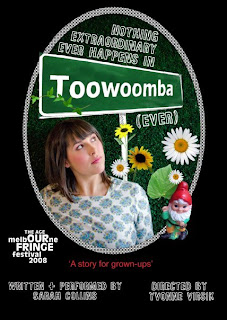
Sarah Collins for Nothing Extraordinary Ever Happens in Toowoomba. (Ever)
DIRECTOR
Benedict Andrews for Moving Target, Malthouse Theatre
and
Yvonne Virsik for Nothing Extraordinary Ever Happens in Toowoomba. (Ever)
DESIGNER
Anna Tregloan for Venus and Adonis, Malthouse Theatre
SOUND DESIGNER
David Franzke for Venus and Adonis, Malthouse Theatre
LIGHTING DESIGNER
Paul Jackson for Moving Target, Malthouse Theatre
NEVER TO BE MISSED CREATOR/PERFORMER – female
Melissa Madden Grey, Venus and Adonis, Malthouse Theatre and Vamp, Malthouse Theatre
NEVER TO BE MISSED CREATOR/PERFORMER – male
Daniel Kitson, The Ballad of Roger and Grace and The Impotent Fury of the Privileged
FESTIVAL DIRECTOR
Kristy Edmunds for her final, unforgettable Melbourne International Arts Festivals.

Outstanding Productions 2008
CABARET
Reuben Krum's Naughty Show, Reuben Krum
and
A Suicide for Winter , The Tiger Lillies
and
Lea Delaria is Naked, Lea Delaria
MUSICAL
Spontaneous Broadway
COMMERCIAL PROGRAM
Blackbird, Melbourne Theatre Company
DANCE
Three, Batsheva Dance Company
COMEDY
Sammy J In The Forest Of Dreams
and
Cell Block Booty, Sisters Grimm

THE BEST OF THE BEST
Ollie and the Minotaur, foogle and 9minds
and
An Oak Tree, Tim Crouch/Melbourne International Arts Festival
and
Romeo and Juliet, OKT/ Melbourne International Arts Festival
The show that will stay with me from 2008 is:
The Ballad of Roger and Grace, Daniel Kitson and Gavin Osborn
(2012 update: Buy the ballad here.)
This story originally appeared on AussieTheatre.com.
There are no shiny trophies, no need to frock up and no one semi-famous to read out the nominations. In fact, there’s no prize at all, except knowing that this is the remarkable work that has inspired me over the last 12 months.

Theatre in Melbourne: even if I could go out every night, I would still miss something worth seeing.
Overall, I wish I wasn’t disappointed by so many commercial productions and wish that people who see commercial shows would also take a chance on the small, independent productions. It’s always going to be hit and miss, but this is where the best theatre continues to be created and it hurts knowing that it’s only seen by a lucky few.
That’s not to say it’s all been good, but it isn’t hard to remember the great stuff. These artists and companies challenge with their content, re-invent form, respect the intelligence of their audiences, and refuse to be bland. Some of them were visiting us from interstate and overseas, but most of this incredible theatre has been created here in Melbourne.
Before the drum roll, let me thank Jo, David, Laura, Karla, Kim and John (the wonderful team of Melbourne reviewers for Aussie Theatre) for their knowledge, their passion, their style and their from-the-heart opinions.
And thank you to everyone who lets us know that you appreciate reading what we have to say.
Outstanding Artists 2008
WRITER
Adam Cass for Oasis Oasis
and
Sarah Collins for Nothing Extraordinary Ever Happens in Toowoomba. (Ever)
DIRECTOR
Benedict Andrews for Moving Target, Malthouse Theatre
and
Yvonne Virsik for Nothing Extraordinary Ever Happens in Toowoomba. (Ever)
DESIGNER
Anna Tregloan for Venus and Adonis, Malthouse Theatre
SOUND DESIGNER
David Franzke for Venus and Adonis, Malthouse Theatre
LIGHTING DESIGNER
Paul Jackson for Moving Target, Malthouse Theatre
NEVER TO BE MISSED CREATOR/PERFORMER – female
Melissa Madden Grey, Venus and Adonis, Malthouse Theatre and Vamp, Malthouse Theatre
NEVER TO BE MISSED CREATOR/PERFORMER – male
Daniel Kitson, The Ballad of Roger and Grace and The Impotent Fury of the Privileged
FESTIVAL DIRECTOR
Kristy Edmunds for her final, unforgettable Melbourne International Arts Festivals.

Outstanding Productions 2008
CABARET
Reuben Krum's Naughty Show, Reuben Krum
and
A Suicide for Winter , The Tiger Lillies
and
Lea Delaria is Naked, Lea Delaria
MUSICAL
Spontaneous Broadway
COMMERCIAL PROGRAM
Blackbird, Melbourne Theatre Company
DANCE
Three, Batsheva Dance Company
COMEDY
Sammy J In The Forest Of Dreams
and
Cell Block Booty, Sisters Grimm

THE BEST OF THE BEST
Ollie and the Minotaur, foogle and 9minds
and
An Oak Tree, Tim Crouch/Melbourne International Arts Festival
and
Romeo and Juliet, OKT/ Melbourne International Arts Festival
The show that will stay with me from 2008 is:
The Ballad of Roger and Grace, Daniel Kitson and Gavin Osborn
(2012 update: Buy the ballad here.)
This story originally appeared on AussieTheatre.com.
11 October 2007
2007 Melbourne International Festival Opens
2007 Melbourne International Festival Opens
No more sleeps. Tonight is the opening of the Melbourne International Arts Festival. For the next 17 days we will be treated to an arts program that has silenced even the harshest critics. Much is already sold out, but there are still opportunities to buy tickets and an extensive free program.
Opening Night kicks off with a free family sing-a-long at 6pm in Federation Square with Grammy Award winning Dan Zanes and Friends.
The highlight of the festival’s first week also opens tonight. Last year we were treated to Robert Wilson’s mesmerising I La Galigo, in 1992 we had Einstein On The Beach. This year he returns with The Temptation of St Anthony. Yesterday afternoon I spent a couple of hours watching Wilson perfect a couple of minutes of this show during the dress rehearsal.
St Anthony is as astonishingly beautiful as the international reviews have said. Wilson creates art that somehow bypasses conscious thought and goes straight to your heart and soul. The gentle and almost haunting opening moments had me wiping away a tear, without even realising what I was feeling. The cast enter from the auditorium with bamboo bird puppets. Its so Lion King! I also cried in the opening scene of The Lion King, but this show is something so, so much more than a commercial musical.
This is music theatre of a calibre and standard we rarely see.
It is possibly Wilson’s most accessible piece. It’s sung in English, is under two hours and has a discernable story line. Starting from the figure of Saint Anthony in Flaubert's novel, this production asks questions about sin, goodness and the temptations of the flesh.
Wilson collaborated with Bernice Johnson Reagon to create Saint Anthony. Reagon is probably best known to our audiences as the founder and artistic director of the divine a capella ensemble Sweet Honey in the Rock. The score is based deeply in the history of African-American music and culture ranging from spirituals, blues, shouts, gospel, hymns, jazz and doo wop to hip hop and rock. It features an all African-American cast of singers and dancers and is accompanied by a live band led by music director Toshi Reagon. Toshi is Bernice’s daughter and also appearing with her own band BIGLovely at the Speigeltent. Toshi Reagon simply has a voice you can’t tear yourself away from.
Then there is the colour. The Festival’s Artistic Director Kristy Edmunds intrigued us last year by saying that Wilson invents colour before our eyes. I can promise you that you will never see lighting and colour as phenomenal as this again. Wilson and lighting designer AJ Weissbard paint the stage with an intricacy comparable to an impressionist master. The colours of I La Galigo were primary and striking. St Anthony’s are subtle and complex and rich. I cannot even begin to describe the multitudes of blue. I just know that I wanted to wrap myself in them. Colour and light are Wilson’s expression of feeling and emotion. He makes words irrelevant.
Wilson is a perfectionist. His precision leaves no room for vagueness or spontaneous artistic interpretation. In the rehearsal a few minutes of the show were perfected over two hours. The first run already had me mesmerized. Then Wilson fixed some spacing, spent minutes directing a performer to make one tiny step and insisted on the exact speed of the removal of a piece of set. These moments would be unnoticed by most, but that is what makes this director’s work so addictive. He takes an already beautiful moment and makes it exquisite.
The Temptation of St Anthony runs from tonight until Sunday at the State Theatre. There are still some tickets available, but be quick or you may miss this spectacular and astonishing work. Go to www.melbournefestival.com.au for details.
This story originally appeared on AussieTheatre.com.
No more sleeps. Tonight is the opening of the Melbourne International Arts Festival. For the next 17 days we will be treated to an arts program that has silenced even the harshest critics. Much is already sold out, but there are still opportunities to buy tickets and an extensive free program.
Opening Night kicks off with a free family sing-a-long at 6pm in Federation Square with Grammy Award winning Dan Zanes and Friends.
The highlight of the festival’s first week also opens tonight. Last year we were treated to Robert Wilson’s mesmerising I La Galigo, in 1992 we had Einstein On The Beach. This year he returns with The Temptation of St Anthony. Yesterday afternoon I spent a couple of hours watching Wilson perfect a couple of minutes of this show during the dress rehearsal.
St Anthony is as astonishingly beautiful as the international reviews have said. Wilson creates art that somehow bypasses conscious thought and goes straight to your heart and soul. The gentle and almost haunting opening moments had me wiping away a tear, without even realising what I was feeling. The cast enter from the auditorium with bamboo bird puppets. Its so Lion King! I also cried in the opening scene of The Lion King, but this show is something so, so much more than a commercial musical.
This is music theatre of a calibre and standard we rarely see.
It is possibly Wilson’s most accessible piece. It’s sung in English, is under two hours and has a discernable story line. Starting from the figure of Saint Anthony in Flaubert's novel, this production asks questions about sin, goodness and the temptations of the flesh.
Wilson collaborated with Bernice Johnson Reagon to create Saint Anthony. Reagon is probably best known to our audiences as the founder and artistic director of the divine a capella ensemble Sweet Honey in the Rock. The score is based deeply in the history of African-American music and culture ranging from spirituals, blues, shouts, gospel, hymns, jazz and doo wop to hip hop and rock. It features an all African-American cast of singers and dancers and is accompanied by a live band led by music director Toshi Reagon. Toshi is Bernice’s daughter and also appearing with her own band BIGLovely at the Speigeltent. Toshi Reagon simply has a voice you can’t tear yourself away from.
Then there is the colour. The Festival’s Artistic Director Kristy Edmunds intrigued us last year by saying that Wilson invents colour before our eyes. I can promise you that you will never see lighting and colour as phenomenal as this again. Wilson and lighting designer AJ Weissbard paint the stage with an intricacy comparable to an impressionist master. The colours of I La Galigo were primary and striking. St Anthony’s are subtle and complex and rich. I cannot even begin to describe the multitudes of blue. I just know that I wanted to wrap myself in them. Colour and light are Wilson’s expression of feeling and emotion. He makes words irrelevant.
Wilson is a perfectionist. His precision leaves no room for vagueness or spontaneous artistic interpretation. In the rehearsal a few minutes of the show were perfected over two hours. The first run already had me mesmerized. Then Wilson fixed some spacing, spent minutes directing a performer to make one tiny step and insisted on the exact speed of the removal of a piece of set. These moments would be unnoticed by most, but that is what makes this director’s work so addictive. He takes an already beautiful moment and makes it exquisite.
The Temptation of St Anthony runs from tonight until Sunday at the State Theatre. There are still some tickets available, but be quick or you may miss this spectacular and astonishing work. Go to www.melbournefestival.com.au for details.
This story originally appeared on AussieTheatre.com.
27 September 2007
MIAF preview 2007
MIAF Preview 2007
The Free Program
 John Cage
If I could have my perfect arts festival...Robert Wilson and Peter Brook would direct a show each. Laurie Anderson and Merce Cunningham would drop by. We’d hear lots of John Cage, there’d be a reworking of Shakespeare, contemporary Butoh, some outrageous cabaret, a fabulous festival club and lots of local artists. So, I’m excited about the 2007 Melbourne International Arts Festival program.
The Melbourne International Arts Festival (MIAF) runs 11–27 October. It's Artistic Director Kristy Edmunds third outstanding program. The 2005 and 2006 programs drew a degree of media (and other) criticism for being too far from the mainstream.
Melbourne’s arts audiences certainly don’t seem to mind. Surely those full houses and cheering audiences must count for something?
Edmunds says, “This year’s program presents artists who have, by definition, changed the possibilities of their art form for all time, and whose individual legacies continue to expand, astound and inspire.” The likes of Cunningham, Brooks, Wilson and Anderson don’t need me to promote them.
Edmunds artistic choice and aesthetic certainly isn’t mainstream. But just because you’re a Phantom of The Opera fan doesn’t mean you won’t love a show like Robert Wilson’s The Temptation of St Anthony. The Los Angeles Times said "Wilson drenches the stage in brilliant colour and beguiling movement. It is breathtaking to watch these singers possess the stage. Each is amazing.” If you like sing along music, spectacular costumes, incredible sets and a world class cast; why not give it a go. And you won’t get the B cast or have to pay for a program.
If you’re still not convinced that this festival is for you and you’d rather save for Priscilla, there are 20 free events in the program. You don’t have to spend a cent.
MIAF has a tradition of free events. The twist this year is that many are presented by the main program artists.
Opening Night kicks off with a family sing-a-long in Federation Square with Dan Zanes and Friends. Zanes was a hit at the 2006 festival and recently won himself a Grammy for Best Musical Album for Children. The night promises no minimalist or post modern compositions, just good old sing-your-guts-out fun.
On the other had, if you are partial to a touch of minimalism, get ready of an all nighter on Friday October 26. Starting at 6.48pm is John Cage’s Musicircus. It finishes at 5.20am. Based on a John Cage event first performed in 1967, it’s a large scale simultaneous performance event involving musicians, dancers, visual artists, poets and a pony. Audiences are invited to move around the BMW Edge anytime from dusk to dawn to explore the multiple performances. You never know who’ll be performing when, so have a nap during the day and be prepared for a coffee or two at 3am.
If you’re unfamiliar with Cage, there’s plenty of opportunity to get to know his work before committing to Musicircus. Often described as avant guard, Cage remains one of the most innovative musicians and artists of the last 60 years. One of his best known compositions is 4’33’ (Four Minutes, 33 Seconds). It’s a three movement work where all the notes are silent. To hear it played live is one of the most genuinely incredible musical experiences.
Cage’s way of looking at music, art and life will be on neon display in Federation Square throughout the festival. Cage Quotes is running daily on the ticker panels that usually promote upcoming events. The quote at the bottom of my emails is from Cage. "The first question I ask myself when something doesn't seem to be beautiful is why do I think it's not beautiful. And very shortly you discover that there is no reason.” I refer to it a lot when reviewing.
Cage was also the Music Director to Merce Cunningham Dance Company until his death in 1992. This festival will be remembered for bringing Merce Cunningham to Melbourne. Regarded as a pillar of modernism and simply known as the greatest living choreographer, Cunningham has led his own company since 1953. Always prizing invention over convention, Cunningham has consistently created new languages for dance.
The Merce Cunningham Dance Company is performing two programs at the State Theatre, but the highlight promises to be The Melbourne Event in Federation Square on Sunday 21 October. The piece will be created by Cunningham specifically for Melbourne and the Square. It will never be repeated and it’s free.
If by now you’re beginning to like this style of art, head to National Gallery of Victoria for the exhibitions from Jasper Johns and Robert Rauschenberg. Johns is known as one of the founding fathers of pop, minimalism and conceptual art, while Rauschenberg is one of the leading figures in modern art. Both designed for the Merce Cunningham Dance Company. Then go to the Gertrude Contemporary Art space for Playground, an exhibition by Daniel Arsham, who has worked with Cunningham more recently.
Other Free Events in Federation Square events include:
Or, if you’re still a bit unsure about the work you see and have some questions, head to The Speigeltent every lunchtime to join Edmunds in discussion with festival artists.
Here's director Kristy Edmunds talking about the program.
This originally appeared on AussieTheatre.com.
The Free Program

If I could have my perfect arts festival...Robert Wilson and Peter Brook would direct a show each. Laurie Anderson and Merce Cunningham would drop by. We’d hear lots of John Cage, there’d be a reworking of Shakespeare, contemporary Butoh, some outrageous cabaret, a fabulous festival club and lots of local artists. So, I’m excited about the 2007 Melbourne International Arts Festival program.
The Melbourne International Arts Festival (MIAF) runs 11–27 October. It's Artistic Director Kristy Edmunds third outstanding program. The 2005 and 2006 programs drew a degree of media (and other) criticism for being too far from the mainstream.
Melbourne’s arts audiences certainly don’t seem to mind. Surely those full houses and cheering audiences must count for something?
Edmunds says, “This year’s program presents artists who have, by definition, changed the possibilities of their art form for all time, and whose individual legacies continue to expand, astound and inspire.” The likes of Cunningham, Brooks, Wilson and Anderson don’t need me to promote them.
Edmunds artistic choice and aesthetic certainly isn’t mainstream. But just because you’re a Phantom of The Opera fan doesn’t mean you won’t love a show like Robert Wilson’s The Temptation of St Anthony. The Los Angeles Times said "Wilson drenches the stage in brilliant colour and beguiling movement. It is breathtaking to watch these singers possess the stage. Each is amazing.” If you like sing along music, spectacular costumes, incredible sets and a world class cast; why not give it a go. And you won’t get the B cast or have to pay for a program.
If you’re still not convinced that this festival is for you and you’d rather save for Priscilla, there are 20 free events in the program. You don’t have to spend a cent.
MIAF has a tradition of free events. The twist this year is that many are presented by the main program artists.
Opening Night kicks off with a family sing-a-long in Federation Square with Dan Zanes and Friends. Zanes was a hit at the 2006 festival and recently won himself a Grammy for Best Musical Album for Children. The night promises no minimalist or post modern compositions, just good old sing-your-guts-out fun.
On the other had, if you are partial to a touch of minimalism, get ready of an all nighter on Friday October 26. Starting at 6.48pm is John Cage’s Musicircus. It finishes at 5.20am. Based on a John Cage event first performed in 1967, it’s a large scale simultaneous performance event involving musicians, dancers, visual artists, poets and a pony. Audiences are invited to move around the BMW Edge anytime from dusk to dawn to explore the multiple performances. You never know who’ll be performing when, so have a nap during the day and be prepared for a coffee or two at 3am.
If you’re unfamiliar with Cage, there’s plenty of opportunity to get to know his work before committing to Musicircus. Often described as avant guard, Cage remains one of the most innovative musicians and artists of the last 60 years. One of his best known compositions is 4’33’ (Four Minutes, 33 Seconds). It’s a three movement work where all the notes are silent. To hear it played live is one of the most genuinely incredible musical experiences.
Cage’s way of looking at music, art and life will be on neon display in Federation Square throughout the festival. Cage Quotes is running daily on the ticker panels that usually promote upcoming events. The quote at the bottom of my emails is from Cage. "The first question I ask myself when something doesn't seem to be beautiful is why do I think it's not beautiful. And very shortly you discover that there is no reason.” I refer to it a lot when reviewing.
Cage was also the Music Director to Merce Cunningham Dance Company until his death in 1992. This festival will be remembered for bringing Merce Cunningham to Melbourne. Regarded as a pillar of modernism and simply known as the greatest living choreographer, Cunningham has led his own company since 1953. Always prizing invention over convention, Cunningham has consistently created new languages for dance.
The Merce Cunningham Dance Company is performing two programs at the State Theatre, but the highlight promises to be The Melbourne Event in Federation Square on Sunday 21 October. The piece will be created by Cunningham specifically for Melbourne and the Square. It will never be repeated and it’s free.
If by now you’re beginning to like this style of art, head to National Gallery of Victoria for the exhibitions from Jasper Johns and Robert Rauschenberg. Johns is known as one of the founding fathers of pop, minimalism and conceptual art, while Rauschenberg is one of the leading figures in modern art. Both designed for the Merce Cunningham Dance Company. Then go to the Gertrude Contemporary Art space for Playground, an exhibition by Daniel Arsham, who has worked with Cunningham more recently.
Other Free Events in Federation Square events include:
- Jon Rose’s Sphere of Influence on 23 October. Combining digital technology, live performance and a giant white ball rolling around the square at sunset.
- Orbotics [network] which fuses the ancient art of origami with robot technology. You’re invited to bring your bluetooth and wifi connected laptop, PDA or mobile phone to network and interact with the oribots.
- Hidden Inside Mountains at ACMI. With an original score by Laurie Anderson, this film was commissioned in EXPO 2005 in Aichi Japan.
Or, if you’re still a bit unsure about the work you see and have some questions, head to The Speigeltent every lunchtime to join Edmunds in discussion with festival artists.
"If something is boring after two minutes, try it for four. If still boring, then eight. Then sixteen. Then thirty-two. Eventually one discovers that it is not boring at all."
John CageThere is so much to see in the festival that is free. So why not try it for a couple of minutes or more. You may find it’s not what you expected. You may find an expression of beauty and wonder that you have not seen before. You may also discover why so many of us love these festival programs that don’t cater for the mainstream.
Here's director Kristy Edmunds talking about the program.
This originally appeared on AussieTheatre.com.
30 October 2006
I La Galigo
MIAF 2006
I La Galigo
Melbourne International Arts Festival
19 October 2006
The Arts Centre, State Theatre

Robert Wilson’s I La Galigo was everything I expected it be. It is a gentle, hypnotic and perfectly beautiful work of live art. I am embarrassed for Melbourne’s arts community to see so many empty seats on its opening night at the Melbourne International Arts Festival.
I La Galigo is slightly different from a typical avant-guarde Wilson work. It’s only three hours long to begin with (Wilson on speed) and it is based on a narrative text. But Wilson fans don’t need to worry. There are still many slow crossings of the stage, the movement is precise, the communication visual and you can enjoy it without worrying about the story.
For those who like a narrative journey, this one is based on Sureq Galigo, an ancient epic poem of the Bugis people of South Sulawesi. There are surtitles to guide you, but reading the program before hand is advised. As stories go, this one is has it all - unrequited love, the threat of incest, intervention by the gods, child abandonment, a couple of great cats and a satisfying end.
This is a festival filled with explorations of new art forms and aesthetics, but I was apprehensive about the melding of traditional Indonesian with western avant-guarde. Then I saw the similarities, rather than the obvious differences. Traditional Indonesian dance drama is described as a “display of living drawings…. that are not intended to represent anything so much as to charm the mind”. Story unfolds slowly using strong visual images and almost no drama. This could describe Einstein on the Beach (Wilson’s best known work, seen at MIAF 1992).

The synthesis of the ancient and the (post) modern traditions is fascinating and unique. Wilson keeps the recognizable shapes and movements of Indonesian dance, but removes the individual performers personal and emotional interpretation. Yet the experience of the performance remains emotional and moving.
Colour and light are the passion of I La Galigo. It is difficult to describe the impact of colour in this production, but I now understand exactly what Kristy Edmunds meant when she said it invents colour before your eyes. The understanding of it is intuitive, rather than cognitive. We say we “see red” in anger. Wilson captures this exact red. It’s like a cross between a fire engine and a kiss-me-now red lipstick. His heaven is blue, but it’s unlike any blue I’ve seen. A perfect blue sky, mixed with a grey/purple sunset. It's comforting and inviting, but filled with hidden power and threat. Even his white is more than just white. And don’t get me started on the orange. Emotional impact aside, if you have any interest in light and colour in any artistic form, this is an un-missable production.
Text is almost irrelevant in the communication of I La Galigo, but it is chanted in the Bugis language. Fewer than 100 people speak this language today. This totally visual production is keeping an indigenous language alive. It has to be compared to last week’s Ngapartji Ngapartji , that shared an indigenous Australian language with us by teaching us how to speak it.
People did walk out and not return to I La Galigo. I appreciate that it can be a difficult style of theatre to understand, but the connection will come you just accept it, watch it and let it “speak” in its own way. The three hours is irrelevant. My only time check was two hours in and I was disappointed to realise just how much time had passed. Sure it could be told more quickly, but this an epic tale that deserves our respect and our time.
Interview
This review originally appeared on AussieTheatre.com.
I La Galigo
Melbourne International Arts Festival
19 October 2006
The Arts Centre, State Theatre
Robert Wilson’s I La Galigo was everything I expected it be. It is a gentle, hypnotic and perfectly beautiful work of live art. I am embarrassed for Melbourne’s arts community to see so many empty seats on its opening night at the Melbourne International Arts Festival.
I La Galigo is slightly different from a typical avant-guarde Wilson work. It’s only three hours long to begin with (Wilson on speed) and it is based on a narrative text. But Wilson fans don’t need to worry. There are still many slow crossings of the stage, the movement is precise, the communication visual and you can enjoy it without worrying about the story.
For those who like a narrative journey, this one is based on Sureq Galigo, an ancient epic poem of the Bugis people of South Sulawesi. There are surtitles to guide you, but reading the program before hand is advised. As stories go, this one is has it all - unrequited love, the threat of incest, intervention by the gods, child abandonment, a couple of great cats and a satisfying end.
This is a festival filled with explorations of new art forms and aesthetics, but I was apprehensive about the melding of traditional Indonesian with western avant-guarde. Then I saw the similarities, rather than the obvious differences. Traditional Indonesian dance drama is described as a “display of living drawings…. that are not intended to represent anything so much as to charm the mind”. Story unfolds slowly using strong visual images and almost no drama. This could describe Einstein on the Beach (Wilson’s best known work, seen at MIAF 1992).

The synthesis of the ancient and the (post) modern traditions is fascinating and unique. Wilson keeps the recognizable shapes and movements of Indonesian dance, but removes the individual performers personal and emotional interpretation. Yet the experience of the performance remains emotional and moving.
Colour and light are the passion of I La Galigo. It is difficult to describe the impact of colour in this production, but I now understand exactly what Kristy Edmunds meant when she said it invents colour before your eyes. The understanding of it is intuitive, rather than cognitive. We say we “see red” in anger. Wilson captures this exact red. It’s like a cross between a fire engine and a kiss-me-now red lipstick. His heaven is blue, but it’s unlike any blue I’ve seen. A perfect blue sky, mixed with a grey/purple sunset. It's comforting and inviting, but filled with hidden power and threat. Even his white is more than just white. And don’t get me started on the orange. Emotional impact aside, if you have any interest in light and colour in any artistic form, this is an un-missable production.
Text is almost irrelevant in the communication of I La Galigo, but it is chanted in the Bugis language. Fewer than 100 people speak this language today. This totally visual production is keeping an indigenous language alive. It has to be compared to last week’s Ngapartji Ngapartji , that shared an indigenous Australian language with us by teaching us how to speak it.
People did walk out and not return to I La Galigo. I appreciate that it can be a difficult style of theatre to understand, but the connection will come you just accept it, watch it and let it “speak” in its own way. The three hours is irrelevant. My only time check was two hours in and I was disappointed to realise just how much time had passed. Sure it could be told more quickly, but this an epic tale that deserves our respect and our time.
Interview
This review originally appeared on AussieTheatre.com.
30 September 2006
2006 Melbourne International Arts Festival preview
MIAF 2006
Program Preview
12-28 October 2006
The 2006 Melbourne International Arts Festival begins on October 12. Artistic Director Kristy Edmunds and her team have created a challenging, contemporary program that is vibrant and inspiring.
There is the usual degree of media controversy about this year’s offering. The Age described it as straying too far from the “traditional mix” and catering to “too few”. There were similar criticisms about Edmunds’ first program in 2005. However, I saw a lot of shows in that festival and they all had full houses and cheering audiences.
The 2005 program was filled with unfamiliar artists and companies, but they gave us unforgettable experiences and their work has become part of our local artistic language. The unknown gave us the freedom to enjoy the pure emotion created by art. I remember tears at Le Dernier Caravansérail (Odysées) (Théâtre du Soleil) and tears of laughter at Bloody Mess (Forced Entertainment). Thank you Kristy for straying from the “traditional mix” and letting us experience the authentic and the heartfelt.
So what does 2006 have to offer?
The program has a strong focus on collaboration across art forms and among artists. It explores artistic practice by rejecting barriers of culture, form, language, belief and place. By doing so, artists create new art forms and challenge our aesthetics. Robert Wilson invents colour (I La Galigo), Marie Brassard lets us hear human thoughts (Peepshow), Alva Noto and Ryuichi Sakamoto explore what music might look like (insen).
Australian art is presented with the same passion as the best international companies and artists. There are many Australian artists appearing, but they are not segregated as the “local” program. This is a truly international program, with no “us” and “them”.
With an extensive free program, you don’t have to spend to indulge in this event. Visit the Mostlandian Embassy, walk around the Visual Arts exhibitions and don’t miss Of All The People In All The World: Pacific Rim (Stan’s Café). There is also a selection of discount ticket packages available, and local artists can apply for an artist card that entitles them to discounted tickets and entry to the Festival’s artist lounge.
Children are encouraged to create their own art. Following the success of last year’s Kids Club is The Clubhouse – a purpose built venue just for younger audiences to enjoy workshops and performances. I was one of the very few adults privileged to see the Kids Club. It was encouraging, nurturing and just so much fun – children did not want to leave. This year kids can also take their grown ups to the interactive Children’s Cheering Carpet (Teatro di Piazza o d'Occasione) and on the kids’ Visual Arts trail.
Last year Kristy proved that she respects the festival audience and trusts us to find our own path in the program. So, trust this Artistic Director, grab the festival guide and take a chance on someone you are not yet familiar with. My path looks kind of like this:
George Orwell’s 1984 (The Actors Gang). Tim Robbins’ company (yes - the one from the movies). Their mission is to bring socially relevant theatre to a broad public. 1984 reminds us of where we could be without he freedom to express our opinions.
I La Galigo (Robert Wilson). Robert Wilson is one of the creators of Einstein On The Beach. If, like me, you sat mesmerised at the MIAF performances in 1992, you know that a Robert Wilson production is unmissable. If you saw Absolute Wilson at this year’s Melbourne International Film Festival, this is your chance to experience the theatre he creates. I La Galigo is unique, visionary theatre that truly overcomes limits off belief, country and aesthetic. A cast of over 50 Indonesian performers present the epic poem, Sureq Galigo. This may mean very little to us now, but I believe it will be etched into our hearts by the end of the performance. Earlier this week I spoke to the Assistant Director about the creation of the work and what it was like to work with Wilson. Look out for the full story soon.
Blind Date (Bill T Jones/Anrie Zane Dance Company). A multinational company that explore national identity by melding dance with video, live music and monologue.
Voyage (dump type). This Japanese collective create surreal and illusionary work that merges all disciplines.
Ngapartji Ngapartji means, “I give you something, you give me something”. This project has always been one of sharing culture, language and stories. With a cast including elders and young people from the Pitjantjatjara community, the work in progress performance sold out last year. This year we see the world premiere of an epic Australian story that blends the familiar with the unfamiliar. Look out for Christina Cass’ interview with the company in the coming weeks.
Peepshow. Marie Brassard peeps into the forbidden - the perversons, deviations and vargaries of love. Intriguing enough – but it also uses digital technology to totally re-mix Bressard’s voice.
Tragedia Endogonidia BR.#04 Brussels (Societás Raffaello Sanzio). Text is abandoned as a powerful physical language unfolds. A world of emptiness, devoid of warmth. This is not for the faint hearted.
blessing the boats. When poet Sekou Sundiata needed a kidney, five of his friends volunteered theirs. He tells his very personal story by simply talking to us.
Mantalk (Thomas and Wells). This project starts with episodes 4 to 7 at the Melbourne Fringe. If you enjoy it, then episodes 11 to 16 continue at the Festival.
insen (Alva Noto and Ryuichi Sakamoto). Acoustic piano and electronic music. Two generations of artists explore new musical structures. Remember the soundtrack to Merry Christmas Mr Lawrence? Sakamoto composed it.
Ethel. Forget what you think string quartet should be – just come and experience their “distinctive fun, spunk and groove”.
The Ringtone Society. Bringing together adventurous musicians and composers to create a new and unique musical form – the ringtone. And we can download them to our phones.
The Tulse Luper Suitcase Film Trilogy (Peter Greenaway). Promising to be “even more unorthadox than his previous work” . If you like Greenaway – what more do you need to know! Apart from - there is an interactive online game that accompanies the films.
This story originally appeared on AussieTheatre.com.
Program Preview
12-28 October 2006
The 2006 Melbourne International Arts Festival begins on October 12. Artistic Director Kristy Edmunds and her team have created a challenging, contemporary program that is vibrant and inspiring.
There is the usual degree of media controversy about this year’s offering. The Age described it as straying too far from the “traditional mix” and catering to “too few”. There were similar criticisms about Edmunds’ first program in 2005. However, I saw a lot of shows in that festival and they all had full houses and cheering audiences.
The 2005 program was filled with unfamiliar artists and companies, but they gave us unforgettable experiences and their work has become part of our local artistic language. The unknown gave us the freedom to enjoy the pure emotion created by art. I remember tears at Le Dernier Caravansérail (Odysées) (Théâtre du Soleil) and tears of laughter at Bloody Mess (Forced Entertainment). Thank you Kristy for straying from the “traditional mix” and letting us experience the authentic and the heartfelt.
So what does 2006 have to offer?
The program has a strong focus on collaboration across art forms and among artists. It explores artistic practice by rejecting barriers of culture, form, language, belief and place. By doing so, artists create new art forms and challenge our aesthetics. Robert Wilson invents colour (I La Galigo), Marie Brassard lets us hear human thoughts (Peepshow), Alva Noto and Ryuichi Sakamoto explore what music might look like (insen).
Australian art is presented with the same passion as the best international companies and artists. There are many Australian artists appearing, but they are not segregated as the “local” program. This is a truly international program, with no “us” and “them”.
With an extensive free program, you don’t have to spend to indulge in this event. Visit the Mostlandian Embassy, walk around the Visual Arts exhibitions and don’t miss Of All The People In All The World: Pacific Rim (Stan’s Café). There is also a selection of discount ticket packages available, and local artists can apply for an artist card that entitles them to discounted tickets and entry to the Festival’s artist lounge.
Children are encouraged to create their own art. Following the success of last year’s Kids Club is The Clubhouse – a purpose built venue just for younger audiences to enjoy workshops and performances. I was one of the very few adults privileged to see the Kids Club. It was encouraging, nurturing and just so much fun – children did not want to leave. This year kids can also take their grown ups to the interactive Children’s Cheering Carpet (Teatro di Piazza o d'Occasione) and on the kids’ Visual Arts trail.
Last year Kristy proved that she respects the festival audience and trusts us to find our own path in the program. So, trust this Artistic Director, grab the festival guide and take a chance on someone you are not yet familiar with. My path looks kind of like this:
George Orwell’s 1984 (The Actors Gang). Tim Robbins’ company (yes - the one from the movies). Their mission is to bring socially relevant theatre to a broad public. 1984 reminds us of where we could be without he freedom to express our opinions.
I La Galigo (Robert Wilson). Robert Wilson is one of the creators of Einstein On The Beach. If, like me, you sat mesmerised at the MIAF performances in 1992, you know that a Robert Wilson production is unmissable. If you saw Absolute Wilson at this year’s Melbourne International Film Festival, this is your chance to experience the theatre he creates. I La Galigo is unique, visionary theatre that truly overcomes limits off belief, country and aesthetic. A cast of over 50 Indonesian performers present the epic poem, Sureq Galigo. This may mean very little to us now, but I believe it will be etched into our hearts by the end of the performance. Earlier this week I spoke to the Assistant Director about the creation of the work and what it was like to work with Wilson. Look out for the full story soon.
Blind Date (Bill T Jones/Anrie Zane Dance Company). A multinational company that explore national identity by melding dance with video, live music and monologue.
Voyage (dump type). This Japanese collective create surreal and illusionary work that merges all disciplines.
Ngapartji Ngapartji means, “I give you something, you give me something”. This project has always been one of sharing culture, language and stories. With a cast including elders and young people from the Pitjantjatjara community, the work in progress performance sold out last year. This year we see the world premiere of an epic Australian story that blends the familiar with the unfamiliar. Look out for Christina Cass’ interview with the company in the coming weeks.
Peepshow. Marie Brassard peeps into the forbidden - the perversons, deviations and vargaries of love. Intriguing enough – but it also uses digital technology to totally re-mix Bressard’s voice.
Tragedia Endogonidia BR.#04 Brussels (Societás Raffaello Sanzio). Text is abandoned as a powerful physical language unfolds. A world of emptiness, devoid of warmth. This is not for the faint hearted.
blessing the boats. When poet Sekou Sundiata needed a kidney, five of his friends volunteered theirs. He tells his very personal story by simply talking to us.
Mantalk (Thomas and Wells). This project starts with episodes 4 to 7 at the Melbourne Fringe. If you enjoy it, then episodes 11 to 16 continue at the Festival.
insen (Alva Noto and Ryuichi Sakamoto). Acoustic piano and electronic music. Two generations of artists explore new musical structures. Remember the soundtrack to Merry Christmas Mr Lawrence? Sakamoto composed it.
Ethel. Forget what you think string quartet should be – just come and experience their “distinctive fun, spunk and groove”.
The Ringtone Society. Bringing together adventurous musicians and composers to create a new and unique musical form – the ringtone. And we can download them to our phones.
The Tulse Luper Suitcase Film Trilogy (Peter Greenaway). Promising to be “even more unorthadox than his previous work” . If you like Greenaway – what more do you need to know! Apart from - there is an interactive online game that accompanies the films.
This story originally appeared on AussieTheatre.com.
I La Galigo: The Colour of Heaven
MELBOURNE INTERNATIONAL ARTS FESTIVAL 2006
Interview with Rama Soeprapto, Assistant Director of I La Galigo

One of the most anticipated events of the 2006 Melbourne International Arts Festival is the Robert Wilson epic I La Galigo. I have only seen one of Wilson’s works (Einstein On The Beach, MIAF1992). Visceral, mesmerising and visually addictive, it was enough to change my concept of what theatre can be. Last week I spoke with I La Galigo Assistant Director, Rama Soeprapto, about working with Wilson, the international reception of this work and the colour of Heaven.
With a cast of over 50 of Indonesia’s finest performers, I La Galigo was developed through a workshop process in Bali. Uniting theatre, dance, music and poetry, it is inspired by Sureq Galigo, a centuries old epic poem of the Bugis people of South Sulawesi.
Working with a traditional narrative is an unusual course for director Robert Wilson. He has been described by The New York Times as “A towering figure in the world of experimental theatre”. Since the late 1960s his productions in the US and Europe have defined the avant guard, whilst questioning and shaping the look of theatre and opera.
Rama Soeprapto’s respect and admiration for “Bob” is very clear, as is his love for this production. His background is dance, visual arts, film and video, and told me he got the job by convincing Wilson that, “I’m here to learn and I really want work hard”.
His primary role was to translate Wilson’s vision to the artists of the cast. This not only involved translating language, but explaining contrasting, and somewhat contradictory, concepts of theatre and performance.
Sureq Galigo has traditionally been told through dance. Soeprapto explains that the traditional Indonesian way of dance is based on feelings. “Dances use their feelings to perform in the moment”. A performance is flexible, personal and unique.
This is very different from the Wilson tradition, where every nuance of the slightest gesture is an integral part of the performance. This visual language developed through his determination to give context and meaning to artists who are unable to express themselves in a text based world. Having overcome his own childhood learning disability, he started working in hospitals and schools, using theatre games to enable and encourage communication with patients and children unable to communicate. It was here that Wilson discovered the power of the smallest gesture and begun his ongoing investigation into the structure of simple movement.
Soeprapto says, “Bob is very precise…very detailed about how you stand and move.” There is no room for an artist’s changing emotional interpretation in a Wilson work.
Fortunately the melding of western avant guard and the traditional Indonesian has created something stunning. I La Galigo has received critical acclaim in Singapore, Amsterdam, Barcelona, Madrid, Lyon, Ravenna and New York, but it was the reaction of the Jakarta audience that has established this production as truly remarkable.
The Indonesian audience know and love this story. Soeprapto says the Sureq Galigo is something they “know from their ancestors” and “have in their minds”. There was naturally some concern about the Wilson interpretation. Fortunately, the Indonesian audiences were “flabbergasted”, when they saw their story “done in such a good way.”
I La Galigo is one of the many works in the 2006 MIAF program that focus on collaboration among differing art forms and the creation of new aesthetics. Artistic Director, Kristy Edmunds, described I La Galigo as “inventing colour right before our eyes”. Intrigued by her description I asked Soeprapto about colour.
He simply replied that “the genius side of Bob Wilson” is how he brings colour into a performance. He will spend a week perfecting a colour. Inspired by the natural world, he will also make artists go outside and feel the grass. To recreate the colour, the image and the feeling of grass – they have to know what it physically feels like. Finally Soeprapto asked me if I could imagine “what colour blue Heaven looks like”. Wilson knows, and I am very looking forward to seeing the blue, the green and every other colour of I La Galigo.
This interview originally appeared on AussieTheatre.com.
Interview with Rama Soeprapto, Assistant Director of I La Galigo
One of the most anticipated events of the 2006 Melbourne International Arts Festival is the Robert Wilson epic I La Galigo. I have only seen one of Wilson’s works (Einstein On The Beach, MIAF1992). Visceral, mesmerising and visually addictive, it was enough to change my concept of what theatre can be. Last week I spoke with I La Galigo Assistant Director, Rama Soeprapto, about working with Wilson, the international reception of this work and the colour of Heaven.
With a cast of over 50 of Indonesia’s finest performers, I La Galigo was developed through a workshop process in Bali. Uniting theatre, dance, music and poetry, it is inspired by Sureq Galigo, a centuries old epic poem of the Bugis people of South Sulawesi.
Working with a traditional narrative is an unusual course for director Robert Wilson. He has been described by The New York Times as “A towering figure in the world of experimental theatre”. Since the late 1960s his productions in the US and Europe have defined the avant guard, whilst questioning and shaping the look of theatre and opera.
Rama Soeprapto’s respect and admiration for “Bob” is very clear, as is his love for this production. His background is dance, visual arts, film and video, and told me he got the job by convincing Wilson that, “I’m here to learn and I really want work hard”.
His primary role was to translate Wilson’s vision to the artists of the cast. This not only involved translating language, but explaining contrasting, and somewhat contradictory, concepts of theatre and performance.
Sureq Galigo has traditionally been told through dance. Soeprapto explains that the traditional Indonesian way of dance is based on feelings. “Dances use their feelings to perform in the moment”. A performance is flexible, personal and unique.
This is very different from the Wilson tradition, where every nuance of the slightest gesture is an integral part of the performance. This visual language developed through his determination to give context and meaning to artists who are unable to express themselves in a text based world. Having overcome his own childhood learning disability, he started working in hospitals and schools, using theatre games to enable and encourage communication with patients and children unable to communicate. It was here that Wilson discovered the power of the smallest gesture and begun his ongoing investigation into the structure of simple movement.
Soeprapto says, “Bob is very precise…very detailed about how you stand and move.” There is no room for an artist’s changing emotional interpretation in a Wilson work.
Fortunately the melding of western avant guard and the traditional Indonesian has created something stunning. I La Galigo has received critical acclaim in Singapore, Amsterdam, Barcelona, Madrid, Lyon, Ravenna and New York, but it was the reaction of the Jakarta audience that has established this production as truly remarkable.
The Indonesian audience know and love this story. Soeprapto says the Sureq Galigo is something they “know from their ancestors” and “have in their minds”. There was naturally some concern about the Wilson interpretation. Fortunately, the Indonesian audiences were “flabbergasted”, when they saw their story “done in such a good way.”
I La Galigo is one of the many works in the 2006 MIAF program that focus on collaboration among differing art forms and the creation of new aesthetics. Artistic Director, Kristy Edmunds, described I La Galigo as “inventing colour right before our eyes”. Intrigued by her description I asked Soeprapto about colour.
He simply replied that “the genius side of Bob Wilson” is how he brings colour into a performance. He will spend a week perfecting a colour. Inspired by the natural world, he will also make artists go outside and feel the grass. To recreate the colour, the image and the feeling of grass – they have to know what it physically feels like. Finally Soeprapto asked me if I could imagine “what colour blue Heaven looks like”. Wilson knows, and I am very looking forward to seeing the blue, the green and every other colour of I La Galigo.
This interview originally appeared on AussieTheatre.com.
Subscribe to:
Posts (Atom)