Showing posts with label David Finnigan. Show all posts

06 December 2016

What Melbourne loved in 2016, part 4

Today's moments are from three men whose theatre voices are bold, challenging and totally their own: Daniel Lammin, Stephen Nicolazzo and David Finnigan. We're going to see a lot more of their work of in the years to come

Daniel Lammin
director, writer, obsessive collector
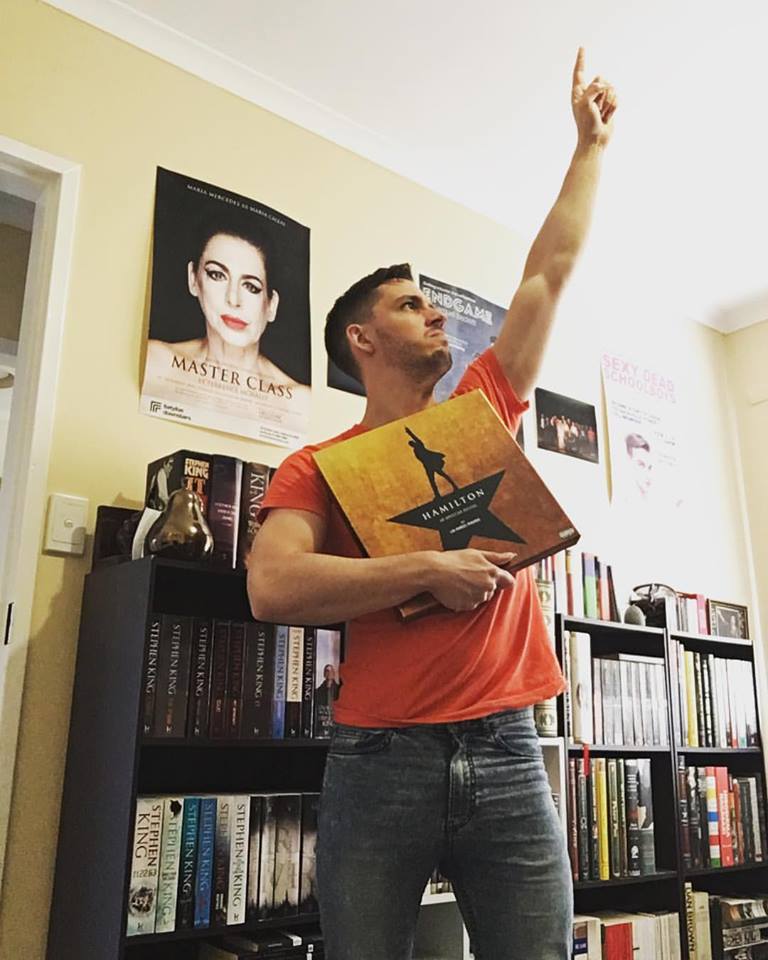
Daniel Lammin's 30th birthday present-to-self selfie

DL's favourite moments in Melbourne theatre in 2016: No piece of theatre this year hit me with as much force as Picnic at Hanging Rock. The book is my favourite Australian book and the film is my favourite Australian film, both having had an enormous impact on me growing up. I also love the work that Matt Lutton, Tom Wright, Zoë Atkinson and Paul Jackson have done together in the past, so consequently my expectations were enormous. The result though exceeded my expectations beyond my wildest dreams. The production captured the concerns of Lindsay’s story, the sexual repression of young women and the Australian landscape’s rejection of us as an invading force, and crafted it into an impressive work of art in its own right, pulsing from Matt’s rigorous direction, Zoë and Paul’s remarkable design, the cast’s tremendous performances and Tom’s diabolical, awe-inspiring text.

It also understood the most misunderstood aspect of the story, that at its heart it is a work of horror, one that crawls under your skin and festers there for the rest of your life.

Watching Picnic was one of the most exhilarating experiences I've ever had in the theatre, both because of what was happening on the stage and what was happening in the audience, a mass of people battered and thrown by the uncompromising force of what they were seeing, jumping and screaming and gasping in unison. The teenager sitting next to me literally jumped out of his chair at a moment of sublime theatrical horror, and sat on the edge of his seat for the rest of the night. It was a perfectly executed theatrical event, one that shows tremendous respect for its source material but with the imagination and rigour to be a great work of art on its own. It left me breathless, exhilarated, disturbed, in awe and in tears, and like the book and film before it, left an enormous and life-changing impact on me and my work as a theatre maker. I confidently rank it as one of the best pieces of theatre I’ve ever seen.

What DL is looking forward to in Melbourne theatre in 2017: Unsurprisingly, I’m incredibly excited to see how the same team approach The Elephant Man. It’s a beautiful story but a theatrically complicated one, and if they apply the same rigour to this one that they applied to Picnic, it could be something really special. I also can’t wait to catch CULL during the Comedy Festival (I missed it during the Fringe and regretted it enormously), and to see what She Said Theatre does next – their work is just getting better and better, and continues to be some of the most important being made.

SM: Daniel wrote and directed Awakening for MUST (performed at Trades Hall). It was an adaption of Spring Awakening by Frank Wedekind (not the musical also based on it) and was one of the most moving and gut-punching pieces of theatre I saw this year. Another MUST show that nowhere near enough people saw. I really hope that someone gives this show another season because it's heartbreaking to think that it won't be seen again – with the same cast please.

Brilliant update: Awakenings has been picked up by the super-wonderful fortyfivedownstairs, so put 10–21 May in your diary now. Book here.

And while you're there, look at the at what else is coming there next year. What a season!

Stephen Nicolazzo
director,  Little Ones Theatre; likes Madonna 


Stephen Nicolazzo

SN's favourite moments in Melbourne theatre in 2016: Hands down, my favourite moments in Melbourne theatre in 2016 were: Cain and Abel (The Rabble ), Gonzo (St Martin’s/Malthouse) and Terror Australis (Leah Shelton at Melbourne Fringe). These works were brave, beautiful, and furious. They were focussed on the craft of visual story telling and the presentation of complex political perspectives in cheeky, adventurous and moving ways.

All were born from Australia’s most courageous female artists: Emma Valente, Kate Davis, Clare Watson and the divine Leah Shelton, and all were a formally adventurous master class in contemporary theatre practice. Finally, each of these works had exquisite craft on display, which to me is an integral part of theatre making. They didn’t bend the rules simply to provoke. They bent them to explore craft and courage.

This is what I want in my theatre. My personal moment of 2016 was getting to tour Dangerous Liaisons for the last time. It has been two years since Dangerous opened at MTC Neon, and it has grown substantially since then, blossomed into a work that I am extremely proud of. It is so rare to develop a work after its initial presentation and in the case of this one, it has been such a unique gift to refine, reassess, and nuance. So very grateful to all of the festivals and presenters who took a risk on our huge mother fucker of a show and to the audiences across the country who have fallen in love with it.

What SN is looking forward to in Melbourne theatre in 2017: The Theatre Works 2017 season. CAN.NOT.WAIT.

SM: I'll see any theatre Stephen makes, but I missed the return of Dangerous Ls and I missed the Madonna night that he programmed for Melbourne Fringe – but I loved lying in bed and watching the pics and videos of it on Twitter.

If you want to support Little Ones Theatre's Midsumma show, donate here.

David Finnigan
playwright

Georgie McAusley and David Finnigan. Photo by Sarah Walker

DF's favourite moment in Melbourne theatre in 2016: This might not be the moment, but I found myself really, really sinking into Nat Randall's The Second Woman performance at Next Wave. I went along intending to stay for a few minutes, found myself there for an hour or two at least. It was weirdly satisfying, so many dimensions to it, but it was sitting afterwards with Jane Howard while she unpacked it for me, that was the real lightbulb moment. I dug that. Maybe that's the combination: good artwork, good analysis, good chats with good humans. That's all you need.

What DF is looking forward to in Melbourne theatre in 2017: I'm looking forward to the major companies retreating further out of touch, the existing funding structures coming apart at the seams and the whole system continuing its histrionic slow-motion collapse, so we can hurry up and see what weird alternatives emerge out of the edges.

SM: I loved seeing Kill Climate Deniers at the Melbourne Fringe, but my moment was reading the play. I was sitting in a cafe in Avalon on Sydney's north coast (which is exactly like the awesome web series Avalon Now, made by real estate site) eating a huge salad with purple cabbage, kale and every super food – while listening to a woman ask why they didn't have a quinoa salad (nuts weren't good enough protein for her) – then being recommended a chocolate cake that was pretty much melted dark chocolate and dates. It was like I was living in the world of Kill Climate Deniers; I WAS in the world of Kill Climate Deniers – and willingly being part of it.

(PS: I love being sent new scripts to read.)

part 1
part 2
part 3
2014
2013
2012

05 December 2016

What Melbourne loved in 2016, part 3

Today we hear from playwrights Fleur Kilpatrick and Keith Gow, and Circus Oz's Rob Tannion.

Fleur Kilpatrick
playwright, director, beagle lover

Fleur Kilpatrick by Jack G Kennedy

FK's favourite moments in Melbourne theatre in 2016: My highlight for the year was Trilogy by Nic Green at Arts House. It managed to be the single most joyful thing I'd seen on stage in a long time, whilst talking about extremely damaging discrimination faced by women for over a century. As a female artist, it posed a wonderful question: how do we talk about the victimisation of our gender without talking about ourselves as victims?

Trilogy was a celebration of the strength, humour and power of women as both individuals and as a community. I left feeling stronger – feeling my cup replenished – and feeling immensely grateful for the women who came before me and changed what it means to be a woman today. Plus, dozens of amazing naked ladies dancing like mad on stage. It was impossible not to beam like an idiot.

My favourite mainstage work was Picnic at Hanging Rock, an outstanding new adaption of an Australian novel. A particular highlight for me was sitting in an audience full of school students during Picnic. Before the show, a girl next to me said to the boy she was with, "I would rather watch eight hours of footage of a public toilet". They then proceeded to scream, gasp and be completely engaged by the work for the entire 85 minutes. At the end, the boy turned to the girl and said, "Oh my heart", as I quietly punched the air next to them and celebrated the transformative powers of live theatre.

My favourite moment of new writing was Kill Climate Deniers by David Finnigin. David stood on stage in a bar and read his entire, ridiculous script, performing every character (all female) and describing terrorists abseiling down from the roof of Parliament House. The audience sat cross-legged on the floor of the bar, laughed and cheered on the story of a federal environment minister with nothing to lose and a killer playlist of house music from 1988 to 1993.

In the midst of the laugher, there was also the totally fascinating story of David's father, a climate scientist, trying to learn how to talk to the media back in the 1980s, when climate scientists suddenly became people the media wanted to talk to and undermine. This was the perfect version of this work. I'm so glad that David went in this beautiful, anarchic direction with the show, rather than placing it on a more conventional theatre stage with a cast and design elements. Plus, the night ended with the dance party I didn't know I needed.


What FK is looking forward to in Melbourne theatre in 2017: I have the privilege of seeing a lot of readings of new work so, rather than talk about things that are programmed for 2017, I want to make mention of a kick-arse script that I really want to see programmed soon! Jessica Bellamy’s The One About the Two Rabbis, which we read in her living room over cheese and dip. Including the playwright, only four people were present and we loved every second of it. Religion meets time travel as Jess explores the religious stories and traditions that still have an impact on the lives of young Jewish women today. I want to see this staged! Someone please make this happen for me!

SM: Fleur adapted and directed Kurt Vonnegut Jnr's Slaughterhouse Five for MUST (Monash University Student Theatre). It's another great show that didn't get a review and wasn't seen by nearly enough people (although it filled the MUST space). What I loved the most about it was how much the student performers and creators took ownership of the content and its story. I remember rolling my eyes when I saw that it was over two hours long, but by interval I was so involved that I would happily have stayed for another couple of hours. 

If you haven't seen a MUST production, please make it a goal for next year.

Keith Gow
playwright, reviewer


Keith Gow. Photo by Keith Gow

KG's favourite moments in Melbourne theatre in 2016: I am not a performer and I don’t harbour that desire at all, but I’ve spent a lot of time on stage this year and a lot of time immersed in shows where I’ve ostensibly been part of the action. Immersive theatre and audience participation can be a tricky business; pick the wrong audience member and you can sink the good will your show has built up to that point.

I spent time on stage with Meow Meow and Chris Ryan in The Little Mermaid at the Malthouse. I wrestled with Adrienne Truscott as she wrestled with her critics in One Trick Pony!

As for immersive theatre, I was quite taken by the one-person-audience experience of The Maze during Melbourne Fringe; following a woman around the dark streets of North Melbourne was troubling in the way theatre should strive to be. I was also part of a two-person audience for Menage and a three-person audience for Dion.

I think theatre should embrace things only theatre can do. Yes, we can sit in the dark and watch figures under a proscenium, but sometimes that feels no different to watching a film. Some of the audience interaction I experienced was uncomfortable, in a bad way. But some of it was thrilling and, by extension, unforgettable.

What KG is looking forward to in Melbourne theatre in 2017: The Malthouse Theatre. I’m always keen to check out the mainstage company’s news seasons from across Australia, once they start revealing them in August. I’m often envious of Sydneysiders and their Belvoir seasons. And their Griffin seasons. I didn’t make it to Sydney once this year, but I will next year.

That said, I’m mostly excited for the Malthouse. I’m excited by everything they have on offer, even though I’m sure there will be some shows that I won’t get along with.

How can I choose between new work from Declan Greene or Nicola Gunn or Tom Wright and Matthew Lutton’s Elephant Man? I can’t and you can’t make me. I’m looking forward to spending a lot of time at the Malthouse and in the Malthouse foyer after.

SM: One night during Melbourne Fringe, I waved and called out to Keith from my car as he was at the tram stop and he didn't react. I watched him walk down the street and not react to anything: he was seeing/experiencing The Maze and was so involved that he couldn't be distracted. It was also pretty damn cool to see his first tv script on live to air TV (Sonningsburg on Ch 31).

Rob Tannion 
Circus Oz Artistic Director


Rob Tannion. Photo by Tania Jovanovic

RT's favourite moments in Melbourne theatre in 2016: I have two very clear moments which defined Melbourne theatre in 2016. The first was seeing Patricia Cornelius’s Shit, at fortyfivedownstairs, directed by the amazing Susie Dee. An outstanding, raw and potent Australian production with an outstanding cast of Nicci Wilks, Sarah Ward and Peta Brady. It blew me out of the water, and still haunts me.

The second moment was during the Circus Oz Big Top season in July at Birrarung Marr. We were contacted via Facebook by a good samaritan to see if we could offer tickets up to a seriously ill 4 year old Indy, and her family. It was Indy’s dream to come to the circus, and being able to make that a reality for her was priceless. Her visit and reaction underlined why we are in the arts and the power it has to positively touch lives.

What RT is looking forward to in Melbourne theatre in 2017: I am really looking forward to the smorgasborg of festivals that Melbourne has on offer: Midsumma, Asia TOPA, Melbourne International Comedy Festival, Yirramboi, Melbourne Fringe and Melbourne Festival… They are like cultural stepping stones crossing my year… I just wish I had the time and money to see everything. Definitely will not miss The Encounter by Complicite in early February at the Malthouse. They are a UK physical theatre company very close to my heart who always pushes boundaries.

SM: I don't know Rob (yet) but every Circus Oz opening night in Birrurung Marr is one of my favourite nights. I love this company; their politics, passion and heart are the voice of Australian theatre that I want to see, in a big top or on the poshest of stages. Circus Oz question the status quo and show what stages, workshops and admin offices can be like when barriers are kicked out of the way and boring choices are rejected.

part 1
part 2
2014
2013
2012

29 September 2016

Review: Kill Climate Deniers

Melbourne Fringe
Kill Climate Deniers
Clan Analogue
303
melbournefringe.com.au
killclimatedeniers.com


A version of this is on The Age/SMH. 

In a Northcote bar, liberal lefties sculled their boutique beers and leapt to their feet to dance and cheer for a play called Kill Climate Deniers. Could Andrew Bolt be right?

At an Australian Parliament House gala, Fleetwood Mac perform – it’s filled with music jokes and has a joyous retro techno soundtrack – and armed eco terrorists attack.

To ensure no wasted taxpayer dollars, writer David Finnigan (from 2013’s controversial Kids Killing Kids) performs this version – it’s been a radio play, an album and an audio tour of Parliament House – using milk crates, an overhead projector and DJ Reuben Ingall.

Finnigan performs all the roles (all female) and interweaves the fiction with the real story about the reaction of a politician and Melbourne commentator Bolt to the play’s development funding from the ACT government.

Its satire is bitingly sharp and its truth could easily be satire. Both hurt with their absurdity.

PS. Remember that I'm tweeting piles of #melbfringe @sometimesmelb.

30 September 2013

FRINGE: Kids Killing Kids

MELBOURNE FRINGE 2013
Kids Killing Kids
MKA and Q Theatre Company
20 September 2013
Fringe Hub, The Warehouse
to 3 October
melbournefringe.com.au


I thought Kids Killing Kids was astonishing; the friend I saw it with was astonished that I even applauded at the end.  We're not the only people experiencing such a chasm of differing opinion about this show that's pushing buttons and forcing a discussion that extends way beyond the smugness of "is it good theatre?".

This is the last show MKA founder Glyn Roberts is producing for the company – he's off to Brisbane to be share his awesomeness – and he's left us with a work that epitomises so much about why he and Tobias Manderson-Galvin founded MKA.

With an overhead projector, a slide carousel, milk crates and a laptop projector, it's a theatre documentary. It's not verbatim or polemic theatre, it's four young Aussie writers (Sam Burns-Warr, David Finnigan, Georgie McAuley and Jordan Prosser) telling us their story of working in Manila with a community theatre company and inadvertently writing a cult play that has thousands of fans and very vocal critics, including the UN Subcommittee for the Victims of Torture and members of the cast.

It begins with an offering of dried mango and pictures of the four at high school in Canberra in the early 2000s. By 2011, they were in Melbourne and packed their backpacks for a month in Manila to work with the Sipat Lawin Ensemble.

The experience of being in a huge Asian city is always a jolt after the space, road rules and general niceness of even the biggest Australian cities. They settled into the routine of odd coffee, Spam for breakfast and hilarious t-shirts, but were still distanced tourists who didn't think twice about taking KFC into a Buddhist monastery. For the sake of all things sacred, don't eat that shit!

But they were there to make theatre and as they became friends with the company members, they argued art and culture into the night and wrote a script adaption of the pulp Japanese novel, Battalia Royale, which is about a class of school children who are forced to kill each other – kids killing kids. (And the internet tells me that the author of The Hunger Games claims to have never read it.)

They handed the script over and came home, thinking they'd never see Battalia Royale again and were much more excited about the experience of being in the Philipines.

But it was performed. The first night to 250 people, the second to 450, the third to 950 – already more than will be able to see this show during the Fringe. The fan response was extreme and thrilling for the playwrights, who experienced it through Facebook, emails and fan blogs filled with fan fiction and kids showing off the fake blood they got on their clothes when they saw it.  Then the critical backlash began.

It's now that this show starts creating the conversation that's becoming so much bigger than the questions it asks.

Four young white privileged 20-somethings wrote a play about children killing each other, set in a country that they didn't know very much about (hell, my first thought was Imelda and her shoes and I couldn't remember when Marcos was disposed). When the criticism started – and a UN subcommittee claiming that you've done bad is very different from a grumpy critic saying they thought you could do better – they learnt a lot more about the country that has a history of violence, including the ongoing arming of children, that most tourists and visitors will never know about or care to find out about.

What I love the most about this work was that it is always these four people telling their story. The politics is complex and confronting, but they share enough for the audience to begin to understand the context, but not enough to overwhelm. Or to really understand it. They leave it up to the audience to decide if we want to go home and read more.

I was curious about the country that I have never been to, but I wanted to know what happened to these four. I wanted to know their story and hear their voices. After all, they are the people in the room with us and they had given us dried fruit.

As writers, they told it with a mixture of honesty and distance, created a structure and likely bent the truth to make the story better.  Their story kept asking "and then what?" and they underscored it with a dilemma that has more questions than solutions.

Did they make a successful piece of art that should be celebrated or a piece of crap that continues to do harm?

They don't answer this. And imply many more questions about violence, the western eye looking at the Philipines, their own skills, what the hell they were doing there in the first place, and whether they should have done or still do anything to address the criticism. Again, they don't answer these questions, but the audience do.

It's these answers that are making this one of the most talked about shows this festival. And this is the success of Kids Killing Kids.

So many shows are forgotten by the time the first post-show drink is ordered; this one is resulting in arguments and discussions and anger and elation. Any work that does this is damn good theatre.

My friend – who looked at me like all sense of morality had left me – thought it was bragging and boring and that they took no sense of responsibility for the sexualised violence that was being celebrated by the thousands of young fans. She thought they learnt nothing from the experience and that they should have taken responsibility rather than celebrated the experience with us.

I hope that they left all the questions so open so that we could have these discussions. What is on the stage is their story and I was fascinated by it. Their ultimate reaction was to make another piece of theatre, and I'll be there for the next version, when they tell us about what it was like to have their new work about their old work dissected by friends, peers and the audiences who love and support independent theatre.

This was on AussieTheatre.com.