Showing posts with label Marion Potts. Show all posts

16 April 2015

Review: Meme Girls

Meme Girls
Malthouse Theatre
9 April 2015
Beckett Theatre
to 2 May
malthousetheatre.com.au

Meme Girls. Art Simone & Ash Flanders. Photo by Pia Johnson

YouTube is only ten years old. Like Facebook and Twitter, it's already hard to imagine life without it. And enough people have now grown up thinking that opening your life and your secrets to the world isn't strange. Meme Girls at Malthouse Theatre is about searching for identity by confiding to strangers on the internet.

Created by Stephen Nicolazzo, Ash Flanders and Marion Potts, the idea came from Flanders's 2011–12 solo show that was directed by Nicolazzo, Negative Energy Inc. For all its self-questioning and stories about his mum, Heather, and boyfriend, Daniel, the piece was unexpectedly defined by his performance of the Horse Woman from the tv show Judge Judy.

It was astonishing. Flanders captured the heartbreak of the woman and found the pin-head spot of balance where poignancy and parody meet to create something that transcends both.

This was a drag verbatim performance of a nobody talking to a camera that doesn't care about the death of her horses!

Meme Girls is more of this and then far more.

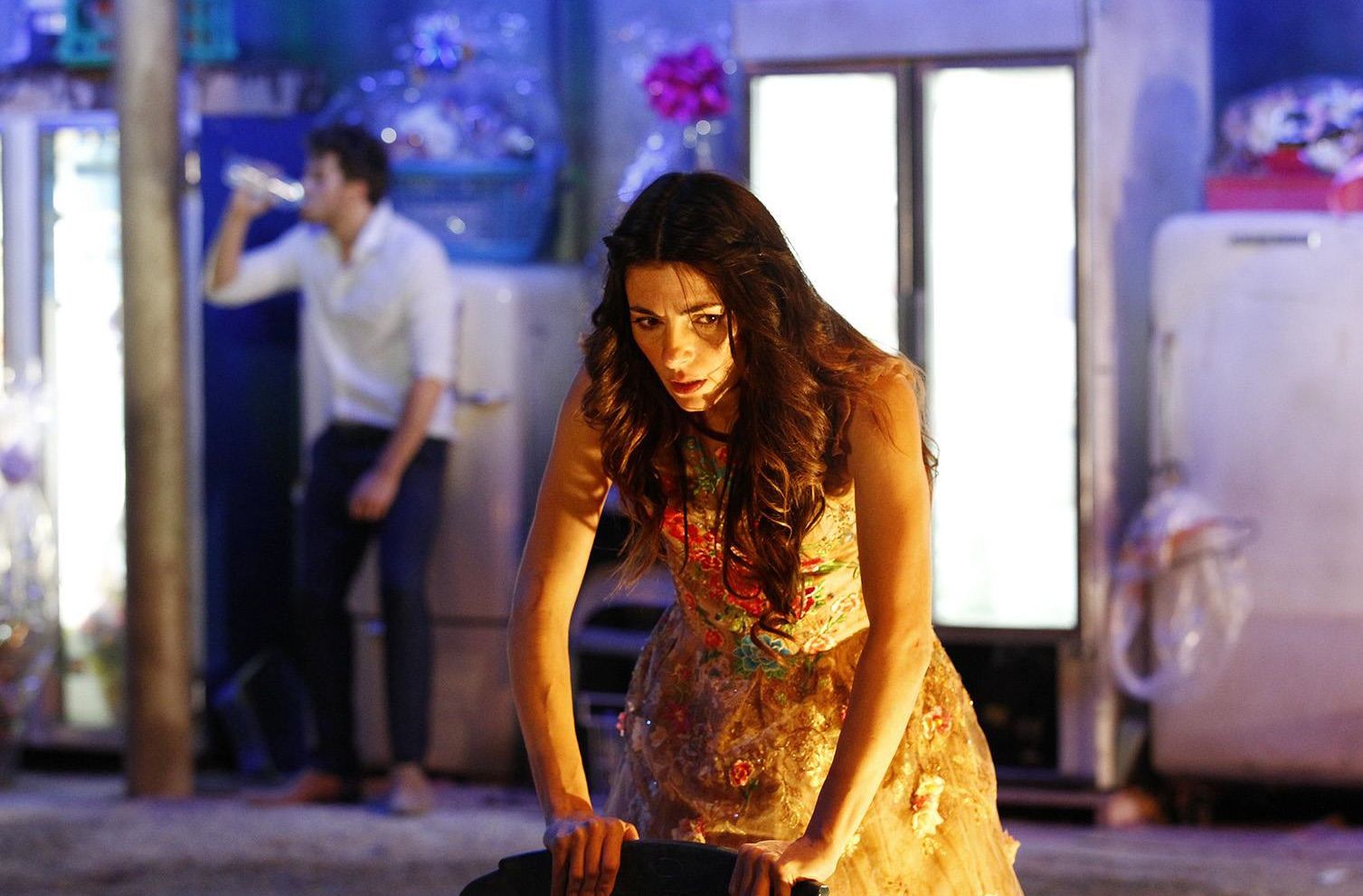
While it's not easy to distract from Flanders when he's on a stage, the design by Eugyeene Teh (set and costume) and Katie Sfetkidis (lighting) is equally as captivating and beautiful. Part–rabbit hole, part Bond-film opening sequence, part–da Vinci Vitruvian Man, it's pure theatre and nothing like a tiny YouTube screen.

And Teh continues his exquisite use of monochrome design: this year, it's aqua. Except Flanders who wears a white pair of tails, and his assistant, drag queen stage kitty Art Simon, in nose-bleed heels and a black corset that shows off an enviable chest.  

All with a re-mixed pop soundtrack by THE SWEATS where Flanders uses those years of fronting an 80s cover band to great use; his "Confide in Me" puts Kylie to utter shame.

But in this world, Flanders isn't Kylie, he's women from You Tube.

Meme Girls.  Ash Flanders & Art Simone. Photo by Pia Johnson 

He's women who have used this anonymous-not-anonymous platform to confide in the comfort of strangers and open themselves to endless abuse. From an atrocious singer who didn't make it though the American Idol auditions to a 68-year-old woman who's about to become homeless, their confessions and their genuine pain are fascinating. And even if we don't actively troll them, we've shared their videos and laughed at them. 

And this is where Meme Girls is unique. Whereby in Negative Energy, Flanders used the Horse Woman to talk about himself, in Meme Girls it's more like the woman are using him. Even though it's a showcase work, it's not about Ash. And even while it's far more about Nicolazzo and his vision, aesthetic and obsessions, the woman still control the mood and heart of the piece.

It's easy to laugh at the Meme Girls and it's easy to bask in the glorious camp-cum-high-art vision on the stage (and Ash), but it's impossible to forget the world where it comes from and to be left wondering if we're the mean girls.

This was on AussieTheatre.com.

29 May 2014

Reveiw: Ugly Mugs

Ugly Mugs
Malthouse Theatre and Griffin Theatre Company
20 May 2014
Beckett Theatre
to 7 June
malthousetheatre.com.au


Melbourne-based writer and performer Peta Brady is also an outreach worker who knows how people fall through the cracks of society and are left to fend for themselves. She's seen the violence, hatred and despair, and the hope. Ugly Mugs is a glimpse of this world that is too easy to look away from.

When a St Kilda resident was violently murdered last year, the media barely raised an eyebrow because she was a sex worker. Her family, friends and life beyond her work were dismissed as irrelevant. I didn't live very far away from her; I might have sat next to her on the tram, but I didn't recognise her.

Ugly mugs lists, updated and distributed by sex workers, describe aggressive and violent clients. Ugly Mugs is the interwoven stories of a sex worker who met one such mug and of a teenage boy who was the last person to see a young woman before she disappeared.

The first story takes place in the forensic morgue where the dead woman (Brady) talks with the doctor performing her autopsy (Steve Le Marquand). The second takes place in the park where the teenagers (Harry Borland and Sara West) met and at the boy's home with his mother (also played by Brady).

A few weeks ago, I went to Melbourne's forensic morgue. It was the 4 am show of The 24-Hour Experience that was part of FOLA (Festival of Live Art). The morgue is a short walk from the Malthouse theatre. As an art experience, we saw the Homicide Room where she would have been taken. The sight of a woman on a stainless steel medical trolley was enough to see her in that sterile room filled with hoses and knives, and as she spoke it was enough to also be walking along streets in St Kilda where street workers are as accepted as lost tourists looking for Acland Street cakes.

Yeah, it's too easy to look away.

Played out on a rough grey asphalt floor (design by Michael Hankin) that begs for bloody scrapes and scars, Ugly Mugs is emotionally raw theatre that invites us to look at our communities a little more closely, without preaching that we must. Dramatically, the second story isn't as tight as the first and having Brady as the murdered woman and the mother leads to some initial confusion, but neither takes away from the impact or heartfelt truth of the work.

As the "Australian writers don't get supported on our main stages" conversation has been active this week, Ugly Mugs is proof that wonderful Australian writing is thriving.

This was on AussieTheatre.com.

26 November 2012

Review: Wild Surmise

Wild Surmise
Malthouse Theatre
Beckett Theatre, Malthouse
15 November
to 2 December
malthousetheatre.com.au


Jane Montgomery Griffiths says her adaption of Dorothy Porter's 2004 verse novel Wild Surmise "is an enactment of the act of love that is reading". Until now, I hadn't read Dorothy Porter. I'm nervous of verse novels; I think they're a bit pretentious. How great to be so wrong. This Malthouse production celebrates Porter and compels a reading of the novel, while relishing being told on a stage.

Alex is an astrobiologist and minor science celebrity. She's engulfed in an affair with Phoebe, an older American scientist, and married to poetry professor Daniel, who's had enough of corporate universities, dreams of getting back at pretentious students and is diagnosed with cancer. There's no comforting romance or confessional resolution in a story that hurts with the honesty that Alex and Daniel can never share.

The first thing seen on the stage is Humphrey Bower (Daniel) reading pages of verse; all the pages of his story that are stuck on the walls/window/mirror of his world. Designer Anna Tregloan and lighting designer Paul Jackson have created an exquisite double-mirrored world with reflections that distort and confuse like a Vegas magician but so beautifully open what feels like a new dimension on the stage where Alex and Daniel can simultaneously be in the same and different worlds.

Director Marion Potts captures why Porter's poetry is so loved, but brings a life and interpretation to the story that lets the theatre own this telling. Porter's words fly with their surprising rhythm and cosmic comparisons, ground with metaphors of terrible Elvis movies and unflusable big black turds, and comfort with the familiarity of St Kilda beach and Mario's coffee. Pott's encapsulates Alex being a Sydney girl with her fumbling with a red expresso machine and never lets the characters become as heroic or honest as their raw thoughts.

In a conventional narrative we hear conversations and imagine the unspoken; in verse we hear the unspoken and are left to imagine the awkward conversations that never share the emotional truth and poetry in their hearts and heads.

Montgomery Griffith and Bower speak verse like it's their only language and there's not a syllable uttered without understanding and intent. Their powerful and painfully truthful performances love the text but show what Alex and Daniel feel about each other beyond the words. They don't speak to each other, but are so aware of the other that they react when the other thinks or speaks about them. It's this detail that adds the heart that creates people we care about, even if their behaviour and thoughts are not what we'd chose.

When we read, we add the detail that makes a story ours.  This production adds the character detail for us, which leaves us free to really listen to Porter's words. It's not like reading, but it captures the passion of falling in love with a book and a writer because its damaged people are so clear that we feel like we're in their world with them.

This was on AussieTheatre.com

Photo by Pia Johnson

And please read Chris Boyd's review.


03 August 2012

Review: Blood Wedding

Blood Wedding
Malthouse Theatre
26 July 2012
Merlyn Theatre, The Malthouse
to 19 August
malthousetheatre.com.au


I wonder what Federico GarcĂ­a Lorca would think about Blood Wedding being performed in Australia 80 years after he wrote it.

His work is so connected to Spain before the 1936–39 Civil War (it is believed he was assassinated by right wing forces days before the war broke out), but great writing comes from truth, and truth is what makes the personal universal. His writing doesn't need an understanding of the politics or the society it came from to tell its story.

Blood Wedding is summarised in its title. Young lovers want to marry, but there are old family issues and unresolved loves; it never offers hope that it's going to end well. For all its politics and anger, Lorca writes about suffering and grief and the utter absurdity of fighting over things that ultimately mean nothing when a love (partner/child/sibling/parent/friend) is destroyed. No wonder Lorca still reaches us.

Director Marion Potts connects the story to Spain with a bilingual adaption, by Ranters Theatre's Raimondo Cortese.  Even though this leaves most not understanding all the words of text and loses a fair chunk of the symbolism and poetry, it's a story that is easy to follow and the dual language gives a beautiful connection with the original writing that is rarely achieved with translation.

This duality of connection and contradiction is continued with a cast including prominent Spanish actors (Irene Del Pilar Gomez, Mariola Fuentes, Ruth Sanco Huerga) and locals (Silvia Colloca, Nicole De Silva, Ivan Donato, Matias Stevens, Greg Ulfan, David Valencia). There's an inconsistency in the overall performances, but it's endearing rather than distracting. Potts's direction seems to always start with character and by letting her cast find their unique connection to the character, the uneven passions always belong to characters.

The Sisters Hayes create the tone by bringing the languages and experiences together with a design that manages to be kitschly fun and dramatically epic. It somehow evokes the closeness of backyard urban Australia and the empty distance of rural Spain with vast wall of patterned bricks (made for Paul Jackson's always exquisite lighting), a row of fridges, a floor of dirt and the universal old-person floral recliner chair covered in protective plastic. Its intricacy draws the audience close and it contradiction instantly allows for the breathing space of laughs amongst the angst and inevitable grief.

I think Lorca would be astonished and proud and excited to see this production (and he'd love Melbourne). It's a production that shows the soul of Lorca and, even if it doesn't emotionally reach as strongly as it could, it's one to see for its understanding and connection and wholeness.

This review was on AussieTheatre.com

Photo by Jeff Busby


22 November 2011

Review: Little Match Girl

Little Match Girl
Malthouse Theatre and Meow Meow Revolution
16 November 2011
Merlyn Theatre, The Malthouse
to 4 December
www.malthousetheatre.com.au


What haven't I already said about absolute wonderfulness of Meow Meow? She's at the Malthouse this month with Little Match Girl and her hoards of international fans are squirming with jealousy that Melbourne (and then Sydney) have such access to this must-be-experienced diva who shreds perceptions of performance art.

Meow has recently graced shows like The Burlesque Hour with her glitter-lipped self, but her last full-length local cabaret was Vamp at The Malthouse in 2008. That show was based on Wilde's Salome, while Little Match Girl starts with Hans Christian Anderson's 1845 story of a little girl who freezes to death rather than return penniless to a violent home. Yet even as Meow reminds us that little has changed in civilised society, she still craves a fairy tale ending and looks for her perfect match as her flames fade and burn.

Like any fine cat, she's aloof, rightfully sure of her exquisite beauty (from the right angle), has remarkably flexile legs and appears contentedly independent until she pounces and demands immediate attention and physical love. But never believe those purrs are for you, as there's always a more enticing lap, and she may have found her flame in just-as-sensational Mitchell Butel, her saviour and handbag.

Working again with the delightful Iain Grandage (musical director and composition), it's bliss to hear Meow with a band and there are super new songs by Grandage and Megan Washington, and a too-delightful Noel Coward number, a "The Book of Love" to bring tears and touches of Richard Wagner, Cole Porter and Laurie Anderson for bonus perfection.

Meow resents attention flowing from her, but Marion Potts (director), Anna Cordingley (design) and Paul Jackson (lighting) create a shiny world worthy of her presence – Jackson's creative lighting is especially stunning – although it's doubtful that Meow will ever let us applaud Melissa Madden Gray.

This review originally appeared on AussieTheatre.com

Photo by Jeff Busby

21 February 2011

Review: 'Tis Pity She's A Whore

 'Tis Pity She's A Whore
Malthouse Theatre
19 February 2011
Merlyn Thearte
to 5 March
www.malthousetheatre.com.au


I'm looking forward to Marion Pott's first program at Malthouse. To date, everything I've seen her direct has excited and inspired me and even if 'Tis Pity She's a Whore didn't leave me dancing in the streets, I certainly enjoyed it.

John Ford wrote Whore in the seventeenth century, not long after the popular playwright Shakespeare died.  Potts loves the complex and centuries-old language that often alienates our lazy contemporary ears and what I love most about Potts's direction is that she shows the emotional intent of the language and tells the straightforward story without dismissing the poetry and sound of the original words.

Some performers, like Laura Luttuada as Putana, shone because they spoke as if it were written today, while others suffered by concentrating too much on presenting the language or relying on the wonderful music that supported the emotional truth of work.

Potts also uses sound and music to bring a deeper emotional depth to her productions and the original music by Andree Greenwall, sound design and live music by Jethro Woodward's and the glorious sound of the wandering angel soprano Julia County ensured Whore's consistency and delicately intertwined the sounds and morality of the seventeenth and the twenty-first centuries.

I haven't read Ford's text, but know Potts cut characters and script to reveal its bones and those bones are a story about incest. The production tried to distance itself from the brother/sister romance to focus on the consequences of the taboo act and the inconsistent morality of everyone else. It's no revelation that the presentation of women as virgins, madonna mothers or whores hasn't changed too much since, neither has the double sexual standard of men and women – which is handed to the awesome Chris Ryan as a one person bogun-stud chorus.

I would have loved to see the love between Annabella and her brother Giovanni at the centre of tale. To have their romance as irresistible as teen lovers Romeo and Juliet and to make the audience hate themselves for wanting these two together, blessed by their family and loving their baby (who would have all its chromosomes). Just as Ford's world was clinging to ideas of absolute rights and wrongs – those Puritans had some impact – so is our world. Incest is an almost a universal taboo. We still joke about Tasmanians marrying their cousins and loathe to reveal any great grandparents who were first cousins. To have an audience blubbering at their deaths (of course they die) instead of feeling relieved that the problem is solved would have been a far more interesting conclusion and emotionally disturbing night of theatre.

So, 'tis pity that this Whore confirms our morality, rather than questions it – but I still look forward to the seeing whatever Marion Potts directs.

This review appears on AussieThearte.com

Photo by Jeff Busby

30 September 2010

Marion Potts Lecture and MTC 2011

How can it already be time to think about 2011?

If you're thinking about what theatre subscriptions to give as the big December present, MTC 2011 is now open and Malthouse is teasing us with their new Artistic Director. 

Marion Potts is the new 2011 Artistic Director of Malthouse Theatre and presented the 2010 Rex Crompton Memorial Lecture last week. Don't worry if, like me, you missed it because Malthouse have given us the pdf of her speech. I'm excited.


The MTC also recently announced their 2011 season, Simon Phillips' twelfth and last season with the company. 

Of course, it'll be a hoot and a half to see Geoffrey Rush as Lady Bracknell and Ewen Leslie as Hamlet, and it's wonderful to see new works by Melbourne writers (and darlings of the independent scene)  Robert Reid and Lally Katz; especially as both are directed by Aiden Fennessy, which makes me smile.

But nothing has made me as excited and terrified as Don Parties On. Oh yes, David Williamson has written a sequel to Don's Party. Garry Macdonald is in it and Robyn Nevin is directing. If it's as brilliant as the original, I'll take back everything I've said about Williamson's recent works. If it's the biggest car crash to ever hit an Australian stage...well I won't be the only vitriolic blogger.


11 August 2010

Review: Sappho... in 9 Fragments

Sappho... in 9 Fragments
Malthouse Theatre
4 August 2010
Beckett Theatre, CUB Malthouse
to 21 August 


With passion, honesty and humour, Jane Montgomery Griffiths makes Sappho... in 9 Fragments a show not to miss if you like theatre with guts, heart and brain,

Sappho was born in Lesbos and wrote in the sixth and seventh centuries BCE. Her remaining fragmented poetry speaks of desire and love and, as Griffiths says, she is as dykonic as Martina and k.d, and as much loved by the cliterati as Jeanette Winterson.

Writer, researcher and performer Griffiths weaves her impressions of Sappho with the story of a young woman's steps into a sexual world of passion and indifference, longing and humiliation. With images like trying to warm a room with a hair drier, she brings this poetic and metaphorical world into our own awkward lives, and adds a relevance and understanding to the academic nature of the study as she laments that Electra became a more popular name than Sappho, because a matricide is preferable to a lesbian.

First seen naked with a shaved head, Griffiths's toned androgyny is as open and complex as Sappho's work. The addition of comfy undies help to define her gender and outlook, and a lush fur coat adds power, control and something to hide behind.

Anna Cordingley's clever costumes wrap Sappho in meaning, and her beautiful design, featuring a glass case slowly emptying of honey in a world that could be cut from an ancient Greek temple or newly-designed coastal home, underscores the text with its own revelations. This is the first time, I've seen Cordingly's design at one with the text and it makes her work shine, as does Paul Jackson's exquisite lighting.  Jackson knows the power of light and colour and lets it be so much more than a statement about what we can or cannot see.

Originally performed three years ago, Marion Potts has re-staged  Sappho... in 9 Fragments for Malthouse. Potts, who recently directed Griffiths as an unforgettable Goneril in Bell Shakespeare's King Lear, lets her actors find a very personal response to their characterisation, but ensures that the character stays in control, while her staging creates an unconscious reaction to the text by always keeping the whole picture alive. With these performances as the bar, we can hope to see more of Griffiths, as Potts become Artistic Director of Malthouse Theatre in 2011.

This review appears on AussieTheatre.com.

Malthouse preview


And look who was cool enough to be in Red Dwarf...

31 May 2010

Review: King Lear

King Lear
Bell Shakespeare
28 May 2010
Playhouse, The Arts Centre


Walking across Prince's Bridge after King Lear, I overheard a couple discussing Edgar and Edmund. How brilliant is that? Bell Shakespeare's production told the story so well that people were leaving the theatre talking about the characters, not the actors.

It's hard to believe that it was 20 years since John Bell established a company dedicated to our Bard and are celebrating with a national tour of King Lear, with the company's namesake playing the king for the third time in his career.

Director Marion Potts (soon to be Artistic Director of Malthouse Theatre) makes character a priority and ensures that every heightened syllable brings the audience closer to the truth and madness  by allowing each performer to develop a very personal interpretation of their character. Jane Montgomery Griffiths's Goneril is especially fascinating, Peter Carroll's Fool is how I will think of this Fool from now on and Bell's Lear is clearly the from-the-heart interpretation Bell has always wanted to show.

Supporting the cast, story flows from Dale Ferguson's understated stage design and his "robes and furred gowns" unashamedly declare power and status.  Act One is accompanied by Bree van Reyk's on-stage percussion punctuating the language, building the tension and becoming such an integral guide in the world that characters freely add their own emphasis and beats; it's removal in Act Two leaves a world searching for guidance.

Bell Shakespeare grace our main stages and also work consistently to bring the Bard's tales to "all Australians, no matter who or where they are". With school programs,  a regional teacher's scholarship and remarkable programs like the Hearts in a Row (HIAR) partnership with The Big Issue, this company refuse to think that Shakepeare is just for fizz-swilling toffs.

Edgar closes King Lear with a reminder to bloggers and reviewers:  "Speak what we feel, not what we ought to say." I say that this is the kind of Shakespeare that I love.

This review appears on AussieThearte.com

30 January 2009

Grace

Grace
Melbourne Theatre Company
7 January 2009
Fairfax Studio, the Arts Centre


MTC’s 2009 season starts with Grace, a comprehensive debate about religion, belief, faith and love. It’s another play about middle aged academics in crisis, but no one can ever say that this company don’t target their core audience.

Originally performed as On Religion, Grace was developed in the UK by Mick Gordon’s company On Theatre. Gordon calls his works ‘theatre essays’. Each is a group-devised piece exploring a specific issue through a dramatic narrative, with works including On Death, On Ego and On Emotion. He co-wrote On Religion with English Philosopher A C Grayling.

Grayling is not a believer and his views sit firmly in protagonist Grace. Gordon’s views are more encompassing with each member of Grace’s family having specific and changing perspectives about religion. Questions arise when Grace’s son plans to become an Anglican priest and everyone is forced to confront their core beliefs when tragedy strikes.

Gordon says, “The theatre demands argument and balance. It’s no good at didacticism. In my experience, an audience will just not accept it.” The script reflects this with a fascinating range of well researched, contemporary and authentic arguments. And this is where the problem sits.

It’s a very well written work, but it feels too much like a philosophy student’s honours thesis. You certainly leave the theatre discussing and questioning the arguments put forward, but not talking about the characters and the world just seen. There was chat about what Noni (Hazlehurst) did and what Brian (Lipson) said rather than what Grace and Tom went though. I spent the rest of the evening discussing whether a practicing Anglican can reject a literal belief in Jesus or the concept of Christ. It’s great coffee talk, but it was academic; it wasn’t an emotional discussion about what I would do in a similar situation or dilemma.

It felt like the story was forced upon the ideas and the characters were developed from arguments and points of view. This may well be the aim of Gordon’s work, but it left his characters lacking in complexity and making decisions that were consistent with the argument, rather than the character.

Nonetheless, director Marion Potts breaks down most of the rhetoric and tells the story with warmth and passion. The most moving moments occurred when there was no dialogue and the characters were able to show us what they were really feeling. Hazlehurst is especially stunning when she reacts to a very long monologue at a grave side.

The casting is perfect. Hazlehurst and Lipson are joined by Grant Cartwright and Leah Vandenberg and each brings a complexity and emotional life to their character that isn’t evident in the writing.

Adam Gardnir is on his way to being one of the must have designers in the country and Grace is his first main stage design for the MTC. The design initially seems quite obvious and practical, but as the story unfolds, it shows its suggestiveness, and ultimately reveals its symbolism and complexity.

Grace is well worth seeing for the calibre of the creative team. Its writing is sure to encourage many discussions, but would be so much more powerful if it could break free from its own restraints and create a world not so strictly governed by text book debate.

This review appeared on AussieTheatre.com.

30 April 2008

Venus & Adonis

Venus & Adonis
Malthouse Theatre Company and  Bell Shakespeare
20 April 2008
CUB Malthouse, Beckett Theatre


“She’s love, she loves, and yet she is not loved.” When Shakespeare wrote his poetic interpretation of the Venus & Adonis myth, he knew that thousands of years had not changed the dilemma of being a woman who loves. Malthouse Theatre and Bell Shakespeare continue to explore the nature of this myth in an original, complex and resonating production.

As humans, we are forever drawn to myth and tales that have existed since the first stories were told. How we tell them changes, but the eternal nature of human emotion and experience repeats though each generation of storytellers. Director Marion Potts and dramaturge Maryanne Lynch use the Bard’s interpretation to re-tell the Venus myth. What they have brought into our contemporary theatre is an intricate and powerful exploration of women and love. In a timeless hotel room, in the forest of a city, woman remains an untouchable goddess, a filthy whore and every powerful and powerless incarnation in between.

There is no Adonis on the stage. We, as audience, take on this role. We watch, are seduced by and reject the advances of Venus, played by, the perfectly cast, Susan Prior and Melissa Madden Grey. Our rejection is figurative as both are outstanding and it’s only theatrical convention that stops the audience from leaping up to join them. I’d watch Melissa Madden Grey cross the road. The amazing Meow Meow aside, Madden Grey’s range has taken her effortlessly from The Production Company to Pina Bausch Tanztheater. Can she do Shakespeare? Of course she can, and does it in a way that makes us want to keep watching and listening. Susan Prior contrasts and complements Madden Grey. Their performances seamlessly merge and separate as each new level of Venus is exposed.

In fear of repeating myself, the Malthouse design team keep getting everything right. Anna Tregloan’s set and costume encapsulate the complexity and timelessness of the myth, and the conflicting restriction and freedom of the women. Paul Jackson’s lighting continues to support and emphasise every emotion on the stage and David Franzke’s sound brings a remarkable element to the production, as the amplification almost turns us into voyeurs, rather than invited watchers. And he lets us hear AndrĂ©e Greenwell’s equally perfect composition.

Each element of this production is stunning, but as a whole there seems to be something missing. I found myself admiring the micro, because I wasn’t completely engaged by the macro. I’m not sure why. Perhaps I was trying too hard to interpret and understand, rather than just enjoy.

Venus & Adonis is original and captivating. Like all myth, we don’t really need to consciously understand it to get the full emotional benefit. Enjoy this work by letting the images seep into your unconscious and see what feelings and memories or your own appear.
 
This review originally appeared on AussieTheatre.com.