Showing posts with label June 2013. Show all posts

05 July 2013

Review: The Crucible

The Crucible
MTC
27 June 2013
Southbank Theatre, The Sumner
to 3 August
mtc.com.au1


Arthur Miller's The Crucible was my favourite play when I was 17 and, along with Lillian Hellman, Miller was my favourite playwright. This play made me read the rest of his work and so many more by mid-twentieth-century American writers. It opened the door to an astonishing and powerful library. But it's been over a quarter of a century since I read it, so, yesterday, I grabbed my high school copy (which tells me I wrote an essay about its fire symbolism) and read it again.

It's definitely a product of his time. First performed in 1954, Miller wrote a play about the seventeenth century witch trials in Salem, Massachusetts, as a response to US Senator Mcarthy's communist trials in the 1950s, which were especially devastating to writers, performers and anyone connected to the evil liberal arts. In high school, we learnt that this was an allegory, a damn fine one.

Still, as I read it, I was struck by just how relevant and powerful a production could be today in Australia. It's a world where women (and their supporters) are attacked, trialled and killed for no reason other than their gender. They are trialled by middle-aged men who base their findings on a belief in a big male god and on their certain belief that young women must be possessed by the big male devil because they surely couldn't be behaving like scared children. The Crucible or Ditch the Witch or Grow up Lindsay. Or, it's a world where women – especially young women – are harlots or angels; a world where a middle-aged man possibly rapes his teenage servant (subtextually, it can go rape or consent) in a barn, who is then fired by the man's wife (ensuring she can't get work) and later declared a whore by the man who certainly took her virginity and treated her like crap.  Maybe the MTC's production isn't just a star vehicle for Diver Dan from Seachange?

With the text still very fresh in my mind, I was excited about this production.

My excitement lasted seconds.

I think director Sam Strong made a bad sit com about the Salem witch hunts (as a star vehicle for Diver Dan in the worst wig ever put on a stage) by ensuring that any faith, belief or hope is a joke.

But that's just me hazarding a guess. So, what about some facts? Well, there were a lot of giggles on opening night – and some guffaws. There are some jokes in the play, but it's not funny. On the page, the scene where Diver Dan declares "whore" and the teenage girls ensure his arrest are chilling; they got the biggest laughs of the night.

Why?

No one in that stage world believes in the god they profess to believe in. Every character in The Crucible acts from their belief in God AND Satan and their fear of eternal suffering. Even the non-believers believe to some extent; belief is the rule that governs this world. They believe in the same way that Senator McCarthy believed that communists were real and could destroy America. They believe it like we believe the sun will set tonight and that Myki is a force of evil.

A play about god and belief can never make sense in a stage world that's godless. I think that's why we laughed so much.

Or it could be the odd acting choices. Act 1 takes place in a girl's bedroom. Depending on the charaters' knowledge, this child is either very ill, terrified or possessed by the devil, but the unconscious child is ignored by everyone around her, unless she's being spoken to or examined. Eleven people pass through the room and 10 of them treat the child – who is either very ill, terrified or possessed by the devil – like she's a beige rug on the bed. No wonder we laughed when the good Reverend Hale asked for help in case she flew away. The eleventh character, Rebecca Nurse, was the only one who looked at the child with any semblance of care and tried to cover the girl's naked legs.

But would I have liked this production when I was 17? Maybe.

After all, Dale Ferguson's design of a pure white building in a hostile black world is stunning and made more so with Paul Jackson's lighting that creates a parallel shadow play. And Julia Blake (Rebecca Nurse), Sarah Ogden (Mary Warren), Anita Hegh (Elizabeth Proctor), John McTernan (Giles Corey) and Grant Cartwright (Reverand Hale and only after the interval) get close to overcoming their direction and bringing real life and pain to their characters. And Diver Dan? David Wenham's as authentic and engaging as his wig.

If this were part of an education season, I would have said it's a dull and oddly literal interpretation of a play that deserves better, but this is a $59 for under 30s and a $99 tickets for students on Saturday night ($115 for people not continuing or having completed their education) and you can see the kick-arse dancing monkey for that or take your family to Circus Oz or see the MTC's other work, Solomon and Marion. If I'd spent $59 to see this as a 17-year-old (or around $100 as a grown up), I would have hated the MTC for letting me down so much.

Photo by Jeff Busby.

This was on AussieTheatre.com.

Mini review: The Penelopiad

The Penelopiad
Stork Theatre
30 June 2013
La Mama Courthouse
to 7 July
lamama.com.au


Margaret Atwood (The Handmaid's Tale and so much more) wrote The Penelopiad as a novel in 2005 and it was soon adapted for theatre.

Homer's Odessy tells the tale from Odysseus point of view and Penelope is the pretty little thing waiting at home. Attwood tells it from Penelope's point of view, with the bonus of telling it from after death, when she has the benefit of hindsight. It retains its "read me" origins, but seeing it performed is almost like having the author read it to you, in all the voices that she imagined.

Stork Theatre's production is selling out because it's terrific.

They've decreased the 12 maids to three and it's set in a spirit world cabaret club where the maids (Andi Snelling, Mia Landgren, Jane Barry) play all the parts as Penelope (Carolyn Bock) tells us what it was really like back in Ithaca while her husband went to save Helen, built a big wooden horse and was tempted by all sorts on the way home.

04 July 2013

Mini review: Light Within Darkness

Light Within Darkness
La Mama
30 June 2013
La Mama Theatre
to 30 June
lamama.com.au


Sitting in the always-welcoming La Mama courtyard before the show, a seemingly grumpy dude in an orange shirt and well-grown grey beard tells two people off for talking when he is. Once he has everyone's attention, he asks if any of us "feel sad, politically impotent or the world is not working for you".

Yep.

He goes on to tell us that this is normal and reminds us there are remedies outside of the pharmaceutical industry.

This is Lloyd Jones and he devised, designed and directed Light Within Darkness in collaboration with a 20-member ensemble and the contribution of many more in a process that began last year.

This isn't neat and tidy scripted narrative theatre. It's an experience that changes each night and for every member of the audience.

Starting with a frustrated anger about the medicalisation of normal (if troubled) emotional and physical conditions and the quick-fix diagnoses and dispensing of anti-depressants and the like, it's a show that starts in a far-too- familiar waiting room with numbers and magazines, slides into a Last-Supper tableau of frightening normality and continues to play with and stress that it's ok to not feel perky every day; that it's ok to feel, even if the feeling isn't nice.

As someone who received a quick fix diagnosis of depression and didn't believe it, I was with this show from its premise. Turned out, my diagnosis was incorrect; I had most of the symptoms of "here's a script to make your brain better", but they indicated a different illness. I now take one of those drugs, but am so glad that I refused the initial script because it would have made me feel worse.

Photo by Rick Evertsz

02 July 2013

Review: Story of O

NEON Festival of Independent Theatre
Story of O
The Rabble
28 June 2013
The Lawler
to 7 July
mtc.com.au


Carousel ponies, huffy walk-outs and a personal trigger warning when you pick up your ticket: The Rabble have adapted the Story of O for the MTC's sensational Neon season.  It's confronting and confirming and I loved it so much that it hurt a bit to watch.

I love The Rabble's work with the kind of love that defies any attempt at a star rating. In preparation for their version of Story of O by Pauline Réage, I read the book; the reading was less painful than O's preparation at Roissy, but I didn't enjoy it and had no idea what to expect on the stage.

In 1954, Anne Declos was a successful 47-year-old journalist and novelist when she wrote this tale as a gift to her boss and male lover, who fancied the writing of the Marquis de Sade. Despite winning the prestigious French literary prize, Prix des Deux Magots, she didn't publicly reveal herself as the author until 40 years after it was published.

It's ostensibly about a young woman's complete submission to secure her lover. A submission that includes being unable to cross her legs, multiple penetration by anonymous men (without any hint of lube, condoms or a moment to catch a breath to scream a non-existent safe word), whipping, branding and her ultimate exposure (considered almost too shocking at the time) is the waxing off of her pubic hair. And that's before it gets really de-humanising.

Without beginning an argument about BDSM, O gets no sexual pleasure from her submission. It's not about her; it's about her doing it for him, even when he's not around to witness and even when she realises that he doesn't want her. And it's narrated by a distanced and anonymous voice, whose gentle – almost prudish – prose leaves it as erotic as a Jehovah's Witness magazine. If pornography is meant to arouse, there's something much more to this book than its reputation, and its popularity may rest on how its distanced narration and calm description puts responsibility on the reader to imagine what O feels.

Co-creators Kate Davis and Emma Valente make us see how O feels.

And see it in ways far removed from the novel – but this doesn't matter as they only use a handful of words from the text, which it is as accurate as it needs to be and as creative as it should be.


As co-artistic directors of The Rabble, Davis designed and Valente directed, but it's difficult to sense a clear differentiation. With exquisite beauty and understanding, they've taken this fantasy tale about submission out of the imagination of its readers, queered it up, reversed some genders, whirled it around, put it in close up and thrust it back at us with such bold confidence that we understand how it's impossible to say no.

Aesthetically, the 60s French polo necks, jaunty stripes and elastic garters are given a nod, but O's world isn't wealthy Parisian chateaus. At first, it's a girly dream with merry-go-round ponies and pink flowers scattered on the floor. But horses are beasts to ride and poles are used to tie horses up. And even with its flung ribbons, party hats and ice cream, all is not as pretty as it looks.

The cast are as desirous and pleasing as the world they play in. Gary Abrahams is Rene (O's lover), Jane Montgomery Griffiths is Sir Stephen (who is given O by Rene), Pier Cathew is Anne-Marie (the older lesbian who brands O for Sir Stephen), Dana Miltins is Jacqueline (loved by O and wanted by Rene) and Emily Milledge is Nathalie (Jaqueline's teenage sister who just wants to be like O). None of these relationships are spoken on the stage, but each take their character from the book and let them live in this through-the-looking glass world where everything about their book behaviour is questioned.

Milledge's Nathalie is especially moving and as Miltin's seven-month pregnant belly is ignored by Jacqueline, it's gold-clad roundness says more about the sexual portrayal of pregnant women than words could dare.

Which leaves Mary Helen Sassman as O. Her performance transcends any depiction of O that has gone before. She's scared, hurt, excited and – this is the twist – lets O say "No" and choose to keep going. She keeps going towards boredom, acceptance and far more hurt without ever revealing if O's own desires are met. Sassman's performance is already being described as fearless, but I say it's honest. It's so uncompromisingly honest that I think the walk-outs are because she makes them feel everything that O feels, which is far more confronting than the sex and violence shown.

So far, people have walked out. This is wonderful. How often does theatre create a response so powerful that people are brave enough to walk out when their exit is seen by the audience and the performers? On the night I went, the walk-outs were men and I wanted to run after them and tell them to go back in and really look at the stage, because this is how women are seen. If it's so shocking or offensive to leave when everyone on stage is fully clothed, the sex and violence are clearly faked and when kitchen and domestic appliances are the offending objects, perhaps a sense of the true offence can be felt.

If you want to run, ask why and remember the gift is for those who stay and laugh or cringe or cry or wonder if they should be feeling as good as they do.

Story of O is theatre like no one else dares to make.

Photos by Guy Little

This will also appear on AussieTheatre.com in a couple of days

27 June 2013

Mini review: Cranked Up

Cranked Up
Circus Oz
26 June 2013
The Big Top at Birrurung Marr
to 14 July
circusoz.com


Yesterday was a day of backflips, juggling and falling to the ground. But the Circus Oz mob did it with class and humour and made sure that anyone falling was caught and given a big, safe and loving mat to fall on.

I watched the circus last night. The one I saw was a gazillion times better than the one playing out in Canberra.

Cranked Up doesn't feel as complete as last year's From the Ground Up, but it's impossible for Circus Oz to not be gloriously funny, original and simply awesome.

For 35 years, this company have been a bold and loud Australian voice when others have been scared to peep about equality, diversity and social justice. Circus Oz rock in every way possible from their live shows to community workshops and if you haven't seen them, what are you waiting for?

With FOH staff who welcome everyone and talk to you because they want to (I talked politics with intelligent fesity women while buying hot doughnuts: it doesn't get much better); a $10 program that you want to buy because it's fun, full of info you want to read, celebrates everyone who helps to make the show, designed by someone who cares and printed on recycled stock; and ushering staff who are as terrific as any one on stage, a night at the Big Top would be worth it without the great show.

Maybe if the Big Top planted itself on the lawns of Canberra's Parliament House, our representatives might remember that supporting equality, diversity, social justice and not letting anyone fall is the best way to win friends. And sharing hot doughnuts. Everything feels better with a bag of hot doughnuts.


Photos by Rob Blackburn.

23 June 2013

Mini review: Herding Cats

Herding Cats
Red Stitch Actors Theatre
7 June 2013
Red Stitch
to 7 July
redstitch.net


Herding Cats slipped through my review net. I enjoyed it and will always say "see Red Stitch" no matter what a review says. But I couldn't put my finger on what bugged me about it.

UK writer Lucinda Coxon's very funny and very dark play about isolated 20-somethings taps into the loneliness of living in a society that lets us interact at superficial levels and the dangers of disregarding the superficial as harmless. I loved how she drew us into a confrontation that would never happen and how she took her characters much further and into a much darker place than I imagined it would.

The balance between black humour and social commentary was teetering a bit, but the direction and performances were great, with all finding a personal connection to the story. The design was a bit dull, but didn't distract from the work.

One of the accents annoyed me because I could hear the actor behind the accent and it hadn't settled yet. And I don't always understand the choice to use an accent.

Begin rant.

We do Asian plays without Asian accents and the last show at Red Stitch, About Tommy, was done without accents and still set in Zagreb. I haven't seen a Chekov done with a Russian accent or a Pirandello with a Kingswood-Country-style bloody-wog accent. European opera is sung without accents. Maybe – I mean, of course – it's because they'd sound offensively racist. So why are our theatres so attached to performing UK and American plays with accents? Unless it's intrinsic to the meaning of the text, they distract and put the focus on the actor, rather than the work. (And, no matter how good they are, I suspect they make native speakers cringe. Remember Meryl Streep's Aussie accent in Evil Angels? Few are better than she is, and she still got it wrong.)

End rant.

But this accent would easily settle in a day or two and it didn't take anything away from the work or the character.

I've finally figured out what it was. I could see the actors judging the characters. It's a tiny and very subtle thing, but it's up to the audience to judge the characters. In this style of realistic theatre, if the actors are agreeing with us about their characters, the characters don't live. They have to be seen to be doing what they believe is best. No one wakes up and thinks, "I'm going to make a very stupid choice today".

But my advice is to read the raves about this show or ignore us all, see it anyway and make up your own mind.

22 June 2013

Review: Voyage

Voyage: The Actual and Properly Truthful Account of the Emigration of Thomas Pender
A is for Atlas
21 June 2013
fortyfivedownstairs
to 30 June
aisforatlas.org.au


Thomas Pender was 23 when he took his wife and baby on a dangerous 126-day sea voyage to Australia. People died on the way, they couldn't land in another country because for fear of disease and were quarantined on their arrival in Australia. A boat person arrives.

In 1883, 23 year old Thomas Pender took his wife and baby on a dangerous 126-day sea voyage from England to Australia. People died on the way, on a detour to South Africa for food, they weren't allowed to leave the boat for fear of disease, and on arrival in Sydney they were quarantined for two weeks to ensure the on-board fevers were kept on board. A forefather arrives.

Pender kept a diary of those 126 days. His hand writing is immaculate and precise. His diary is still with us and his great great grandaughter, director Tamara Searle, has made exquisite theatre about their respective journeys through history.

The bare boards of fortyfivedownstairs seem like they were created to be the floor for this show. The performers use every part of the space like it was designed by them, and with only a few suitcases, trunks, costume props and an overhead projector, they create a journey that's as fearful, hopeful, claustrophobic and agoraphobic as a sea journey to the other side of the world can be. And the overhead projector is used in ways that create more emotion and atmosphere than any of the squillion dollar effects currently seen in Melbourne's bigger theatres.

The ensemble (Steve Brown, Kate Parkins, Shannon Quinn, Jon Richards, Brook Sykes
and Leone White) begin by addressing the performers' expectations of the audience and the audience's expectations of the work (yes, I always wonder if anyone is going to take their clothes off and if I'm sitting next to that person's mum). This gently and delightfully brings the audience into the space, lets us get to know the performers, and ensures that their collaboration is as much of the story as Pender's diary. Then, starting with Pender's diary, they play the on-board characters and themselves, while questioning their interpretation of the writing and discussing the truth and fiction of facts.

If we were born here, most of us are a descendent of someone who came to Australia from another country, and maybe if we made this kind of connection to their journey, we'd welcome any and everyone who hopes to escape something by joining us here.

But, as we wonder if Searle's great great grandfather would recognise his own story, this work never screams or even articulates its underlying message. It's much more complex than that and its exploration is theatrical, mesmerising and human.

Voyage is one of the most beautiful and unexpectedly moving works I've seen this year. Its story is so personal for the director, but told in way that ensures that it's our story, no matter when or how we came to Australia.

This will be on AussieTheatre next week.

Photo by Justin Batchelor.

Review: Domino

DOMINO
Attic Erratic
19 June 2013
Abbotsford Convent
to 29 June
atticerratic.com


Young independent company Attic Erratic started performing and working together in 2010 and are well on their way to being on of those companies who you have to see what they do next.

I missed quite a bit of their early stuff, but not anymore. If you don't know them, start with DOMINO.

Firstly, it's on at the gorgeous Abbotsford Convent in the slightly creepy Industrial School (follow the signs near Lentil as Anything – and arrive early to eat at Lentil as Anything) and they sell warm and spicy mulled wine with currents. Winner already.

In a post-apocalyptic dystopian future of forever night, five young men are alone, angry, bored and desperate. Light and hope are things of dreams, but they play a game about the end of the world, not knowing if there's a line between reality and myth.

With a bar and a huge space to use (the same space where a rat up-staged everyone at the 2012 Last Tuesday Society's Xmas special), the design team (Laura Harris: set and light, Lucy Welsh: projection, Zoe Rouse and Mia Zielinski: costume, Tom Pitts: sound and music) have created a space that begs to be entered, while creating a sense of nervous fear with dark corners and unseen rooms where wolves can hide.

Director Danny Delahunty lets the creative and beautiful language of Melbourne writer Giuliano Ferla's script lead the story and define a world that's so far from ours that the rhythm and meaning of English has evolved.  It's like a memory of language; it makes sense, but isn't quite right. And it's a world without women. A world without easy comfort and the eternal life of procreation has to be found elsewhere.

Actors Alex Duncan, Joseph Green, Kane Felsinger, Matt Hickey and Spencer Scholz relish the work and let us see beyond their facade of bravado and toughness. Nerves could be seen on the preview I saw, but they have nothing to be nervous about.

This is a powerful work that questions masculinity and the future of all of us in a time when playing the "gender card" brings calls of unfair.

This will go up on AussieTheatre next week.

21 June 2013

Review: By Their Own Hands

NEON Festival of Independent Theatre
By Their Own Hands
The Hayloft Project
14 June 2013
The Lawler
to 23 June
mtc.com.au


I can't say enough wonderful about the MTC's Neon Festival of Independent Theatre. Five of Melbourne's most loved, most successful and most challenging independent companies were asked to create something new – no restraints.

We're still talking about Daniel Schlusser Ensemble's Menagerie (based on the works of Tennessee Williams) and Fraught Outfit's On the bodily education of young girls (based on a 1903 novella and developed with a cast of teenagers from St Martins Youth Theatre). I wrote about them here.

The Hayloft Project's Benedict Hardie and Anne-Louise Sarks also adapted.  By Their Own Hands is the story of Oedipus and Jocasta; loved by the ancient Greeks and so popular that Freud based his own legacy on it. But do we really know the story and the people in it?

Anne-Louise and Benedict begin by simply telling the story, and telling it in a way that gets the audience involved without any embarrassment. There's nothing to be feared when they ask the audience to join them on the stage, and you might only be disappointed if you're not chosen as a cast member. (As Sphinx, I can end the year happy that I was recognised for my true talent.)

Then we're sent back to our seats and they tell the story again. It's now that a huge plastic curtain and Marg Horwell's design comes into play and they tell the tale in ways that remind us how these ancient tales are as much about now and us as they were 2500 years ago when Sophocles, Euripides and Aeschylus were all the rage.

The title alone takes responsibility away from the gods and fate. They show how conflicted a man must be to consider killing his baby, and the moment when Jocasta realises who she married is soul chilling.

There's been a lot of boring hoo-ha in recent weeks about the evils of adaption V original work. This season is proving that there's nothing unoriginal about adaption. These works are sending us back to the source texts (what would Freud say about me having all the Electras and none of the Oedipuses in my book shelf?) and letting us see them again with such fresh eyes.

I don't like the phrase "intelligent theatre", but By Their Own Hands explores the relationship between audience and stage and re-tells a known story so powerfully and originally that I could feel new brain cells growing.

And we have The Rabble's Story of O (after Pauline Réage's novel) and Sisters Grimm's The Sovereign Wife (inspired by Aussie-Aussie-Aussie cultural icons like Ken Done and The Man From Snowy River) to look forward to. After The Rabble's astonishing Orlando at last year's Melbourne Festival and having recently read O, I think this may be one of the most unforgettable shows of the year, unless they're outdone by the glorious camp trashiness of the Sisters who have promised/threatened the likes of a character called Poof Cop.

This was on AussieTheatre.com.

Review: Shane Warne, the Musical

Shane Warne, the Musical
Arts Centre Melbourne, Adelaide Cabaret Festival
20 June 2013
Hamer Hall, Arts Centre Melbourne
to 21 June
artscentremelbourne.com.au


Oh Eddie Perfect! You gorgeous, sexy, magnificent beast. You're as hot as King Kong and if you had a fraction of the resources that developed the magnificent monkey, Shane Warne The Musical could tour Australia for ever – or until Warnie does something else that begged for a new song.

The original 2008 version of Shane Warne the Musical (review) made me kind of love our Shane. He's our ultimate anti-hero who finally realises that acting like a dick leaves you looking like a dick.

The concert version has cut some of the old to make room for the introduction of Liz Hurley – I remember when the tweets started and I didn't believe that Liz Hurley would ever date Warnie – and the new stuff's as great as the old.

The new concert version (only seen at the Adelaide Cabaret Festival and here in Melbourne for two nights) clearly lacks the spectacle of full staging, but continues to prove that this show isn't dependent on anything but its music and writing.

It's hilarious and smart and so full of heart and sass that the only disappointment is its two-night run.

I haven't followed cricket since Kim Hughes was captain, but I know what Warnie gets up to. He's a brilliant choice for a musical hero, and Eddie Perfect wrote (and stars in) a show that celebrates the spin bowler who changed cricket, without denying that he's been a bit of a douche along the way; all the while laughing and totally loving everything about the public and media's obsession with his celebrity.

And having what may be the most gorgeous mass of talent ever is just a bonus. There's Perfect, Shane Jacobson (Kenny), Verity Hunt-Ballard (Mary Poppins), Christie Whelan Browne (A Funny Thing happened...), Rohan Nicol, Mike McLeish (Keating), Jolyon James (Moonshadow), Amy Lehpamer (Margaret Fulton), Andy Conaghan and Lisa McCune (easier to list what she hasn't been in). Throw in tight direction from Simon Phillips and music direction from Iain Grandage (whose conducting leads the enthusiasm and joy) and it's hard to get a better night in a concert hall.


As the last week has been filled with ridiculous fighting over the value of King Kong, Shane Warne, the Musical is an apt reminder that there are you-bloody-beauty musicals made in Australia about Australians and Australia (Keating, Margaret Fulton) that don't need squillions to be created.

And let's not forget the absolute gorgeousness of Flowerchildren by Melbourne's Magnormos that finishes on Sunday! (I don't understand how everyone who sees this show falls in utter love with it, but it's not getting the sold out signs that it so deserves.)

But tonight's all about Warnie. If you missed it in 2008, you have to see it to get what the raves were about, and if you loved it then, you'll love it again.

I'd love to see this show out of expensive velvet concert halls and into town halls and local theatres all over the country. It's an awesome work for us theatre snobs, but it reaches way beyond us. This is a show that blokes come to and get up during the show to get another beer. It happened in 2008 and happened in Hamer Hall last night. Dudes got up during the show and came back with beers to watch their Warnie. I scowled at their lack of theatre etiquette, but I fucking love the intent. Yep, this is a show that can be watched while drinking beer and I now wish that I'd asked them to get me one.

Photos by Meredith O'Shea

20 June 2013

Review: Solomon and Marion

Solomon and Marion
Melbourne Theatre Company
12 June 2013
Arts Centre Melbourne, Fairfax Studio
to 20 July
mtc.com.au


In Cape Town in 2006, actor Brett Goldin and designer Richard Bloom left a party and never got home. They were found naked, except for their socks, near a freeway; they had been robbed and shot through the head.  Goldin was playing Guildenstern in a production of Hamlet  that was about to fly to Stratford to open the Complete Works Festival. Writer Lara Foot worked with the same theatre company and Solomon and Marion is the result of her trying to understand the incomprehensible – and incomprehensibly accepted – violence in her country.

It's a beautiful play. Its uneasy undertone of violence and mistrust creates tension, but it's gentle and loving and finds hope in the endless grief.

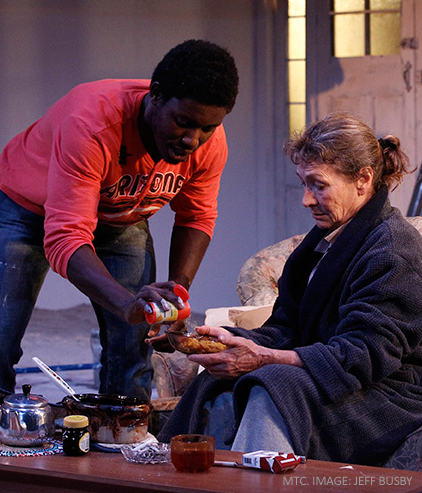
Marion (Gillian Jones) is an old white South African who lives alone in the Eastern Cape. She doesn't want to move to Australia to be with her daughter and grandchildren and leaves her door and windows open, despite the constant threat of violence. Solomon (Pacharo Mzembe) is the black grandchild of Marion's former maid and he turns up one day saying that he's been sent to see her.

In a world that's dominated by loss, poverty and guilt, Foot explores two people who cannot escape the violence and are secretly scared of their own complicity.

In a production where design (Richard Roberts, set and costume; Rachel Burke, lighting; David Bridie, music), performance and script work like one, director Pamela Rabe lets this very place-specific story resonate way beyond its South African borders. As its secrets are dug up and assumptions buried in the hilly floor of sand, Marion and Solomon try to understand why the other is in their life, each wanting the other gone, but terrified that they might leave.

But the night belongs to Mzembe and Jones.  I first saw Jones in the early 80s in Jim Sharman's Midsummer Night's Dream; when Mzembe wasn't even born. You don't forget the great actors when you see them, and on TV and stage, Jones is an actor who leaves ego aside and creates characters who live. Mzembe graduated from NIDA in 2007 and lets us see every nuance of Solomon's complex relationship with Marion, which begins with a confused mix of resentment, respect and pity.

This story had its roots in the kind of violence and loss that creates hatred, but it leaves the hate behind to reveal the broken hearts of two people whose have to live with its consequences.

Photo by Jeff Busby

This was on AussieTheatre.com.

18 June 2013

Review: King Kong

King Kong
Global Creatures
15 June 2013
Regent Theatre
kingkongliveonstage.com


Oh King Kong! You gorgeous, sexy, magnificent beast. Your entrance may be the most spectacular thing ever seen on a live stage. Every time you’re on, the audience is yours for the taking, as all around you pale to dull, despite all manner of shiny costume. You are glorious and unforgettable. If only a fraction of the care, love, money and time that went into your creation was put into creating the story you are doomed to play in.

After a couple weeks of previews and rumours, King Kong opened last night.

It’s spectacular. Visually and technically, this is theatre that we haven’t seen before and it has to be seen just to see its amazing pretty.

Peter England’s design, Peter Mumford’s lighting, Frieder Weiss’s projections and Roger Kirk’s costumes are so WOW! that doesn’t matter that it doesn’t feel like New York or that Skull Island screams Tron. The sea of light, the Skelator Statue of Liberty and the fluffy monkey leotards are so sensorially sensational that it’s easy to forgive the inconsistent style and questionable portrayal of women.

Then there’s the beast created by Sonny Tilders and his team. Kong defies superlatives. With a team of puppeteers (led by Peter Wilson), this amazing critter shows emotion and heart befitting his size; his breath-taking magnificence is the reason alone to see his show. (But if you’re taking young theatre fans who could be scared, it’s worth speaking to someone who has seen it.)

And there are humans to see as well. The huge ensemble is sensational. With choreography by John O’Connell and circus/aerial direction by Gavin Robins, their energy and step-perfection fills the huge theatre as much as Kong’s roars.

Principals Esther Hannaford (Ann, Kong’s love), Chris Ryan (Jack, Ann’s love), Queenie Van De Zandt (Cassandra, a prophet) sing beautifully and bring so much more than they are given to their roles. And they are given so little to work with.

Hannaford even overcomes the endless sniffing of Ann (her girly smell attracts monkeys and men of all sizes) and a dream sequence where she realises she’s an ok woman because dream angels in black pvc corsets tell her she’s hot and sing, “We don’t need no story or director to make us perfect”.

Hot you may be dream angels, but why you are there is one of those mysteries that may never be answered.

The story isn’t there. There’s a plot based on assuming the audience know King Kong’s film story, but it’s filled with illogical leaps, clunky dialogue and the melodrama of unearned emotion.  It feels like it was written around the spectacle (during a tech run, before previews).

Kong deserves some writers. They don’t have to be expensive, award-winning writers, just writers who know story and how to tell story in theatre. People who know that a foreshadowing monkey has to come back; that unearned kisses don’t create love; that if a guy sings a song about Lady Liberty, his story should be about liberty; and that long-legged women don’t fill plot holes.

It’s a slightly dodgy analogy, but I’m going to compare it to a Pixar/Disney film. Films like Wal E, Toy Story and Monsters Inc are visually and technically sensational, but they start, end and are seen by zillions because of their stories. These scripts are written in writers’ rooms and drafted until they are perfect. Every syllable and story beat is analysed and worked until it’s assured that there isn’t a second where the audience will stop caring or drift off. The animation is the icing and ribbon around the cake of the story. Icing is vital and delicious, but doesn’t make sense without cakey substance.

When interval and post-show conversations are “what if they …”, instead of “what about when”, there’s something wrong.

Oh A-M, you’re a writer, so of course you care about the writing; the general public don’t care, they just want to see pretty. No one cares about story.

Think of your favourite stories – book, film, comic, tv, told in the pub. How many of them do you wish were different? How many do you remember just for how they looked? The sleazy producer Carl, who captures Kong, even says in the opening scenes “People want stories”!


So, it looks amazing, the dancing monkey is to-die-for and the cast nearly overcome the woeful story, but what about the music? It’s music theatre after all.

The music is forgettable. It’s not boring, but it doesn’t move the story, show character or add much more than a beat for the spectacle that it’s supporting.

The most successful number is Ann’s lullaby to Kong on Skull Island. Emotionally and dramatically, this is the moment for Ann to tell her secret, to reveal her soul to the god who can never share her truth. It’s the moment the audience is meant to be so with these two that every subsequent obstacle to their survival is heart breaking. Its repetition in Act 2 should leave the audience crying. But it’s a song about the moon. It’s performed beautifully and looks stunning, but it’s gutless.

The music could be removed from the show without affecting the story. I can’t name a long-running or award-winning show that can say the same.

King Kong could be a game changer. There is so much jaw-dropping, razzle-dazzle magnificence on the stage that it’s already changing the rules, but until the same amount of work that created its dazzling glory goes into the writing and the music, it’s just a couple hours of exquisite pretty that’s too easily forgotten.

Photos by Belinda Strodder.

This was on AussieTheatre.com.


15 June 2013

Mini review: Distance

Distance
La Mama
13 June 2013
La Mama Theatre
to 16 June


Ellen and Andrew are no longer together, but are forced into the same room when their 15-year-old son is arrested for attacking another boy, leaving him nearly dead in hospital.

Daniel Nellor's script is full of grief and anger and guilt, as these two try to understand how they raised a violent son and try to not let their own relationship and personal pain dominate the arguments. It's a bit overwritten – the subtext is louder than the writer thinks – but it doesn't take away from its impact.

Director Chris Thompson guides striking performances from Margot Fenely and Kevin Hopkins; Fenely especially, as she lets us see the screaming turmoil that never leaves her head and feel the stabbing black pain in her heart.

I saw this show with a room full of teenagers. As a play about their parents, I expected a few eye rolls and whispers, but they were silent and glued to the stage. This says so much more than I ever could.

It finishes on Sunday.

Mini review: Button

Button
La Mama
13 June 2013
La Mama Courthouse
to 16 June


Someone (Cameron) gave this show the sort of review (bollocking) that ensured that I'd see it.

Button is as cute as a button, but if you don't think buttons are cute, you might not get it. And I'm not sure that I like women in their 50s described as harmlessly cute.

Performers Carole Patullo and Jane Bayly, and director/dramaturg Melanie Beddie have developed a piece about the frustrations of ageing and the negotiation of friendship, and it's clear from the love oozing off the stage that it's a work they loved making.

As a woman-of-a-certain age, I got it and happily laughed along. And as my Nanna had a button box that she let me play with (does anyone say "Lets play with the buttons" today?), I was swept along with the nostalgia.

But it's a bit preachy and sings the obvious instead of showing what it's like to have your body begin to betray you when your mind is finally in the right space and the oddness of realising you're socially invisible.

If you keep buttons, you'll love it. If not, it's not for you, so see something else.

It finishes on Sunday.

Mini review: Bunker

Bunker
La Mama
13 June 2013
La Mama Theatre
to 16 June
lamama.com.au


I'm not sure what Bunker is about, but it's mesmerising and intriguing and has some of the best lighting and sound design I've seen in the tiny box of La Mama.

Created by Greg Dyson, Trudy Radburn and Charlie Laidlaw, and performed by Laidlaw and Radburn, it gives nothing away in the program and all we have to work on is the title.

Sometimes communication has nothing to do with understanding and this short work is fascinating enough to let everyone find their own meaning.

It finishes on Sunday.

13 June 2013

Mini review: Arafat in Therapy

Arafat in Therapy
Jeremie Bracka
8 June 2013
Chapel off Chapel
to 9 June
jeremiebracka.com.au


Jeremie Bracka is a good Jewish boy from Caulfield who studied law, went to Morocco to learn Arabic, worked as a human rights lawyer for the UN and continues to do so in Israel. He's also very funny.

Arafat in Therapy starts with a tea towel joke and there's not too more of Arafat. Where his show really comes to life (and is loved by his audience) is his depictions of the ironies of Israel and of growing up Jewish in Melbourne. As a goy who lived next to Caulfield for 10 years, I know the characters and the world. He shows his upbringing with the kind of love, honesty and belly-laughs that no one could take offence at.

Offence? Any show about Israel is sure to include something that will offend. It's a topic that I will never discuss with some friends because they are my friends and I like them and I don't want to fight about a situation that we may not find a common ground on. For all Bracka's humour and talent, there's nothing in this show to cause offence to his audience – and there was no one in the audience who would know anyone who wears a 'tea towel'.

The closest it came was describing Arabs as lovely people who always offer him coffee. Which is something – humanising characters is what theatre and comedy do best – but it's by no means the parody of the Middle East peace process that it describes itself as and, as he's worked in Gaza, I suspect that Bracka has much stronger opinions that are not on display in this delightfully funny, but ultimately very safe work.

He's also performing in Sydney and in Tel Aviv and Jerusalem later in the year.

10 June 2013

Review: Palace of the End

Palace of the End
Daniel Clarke in association with Theatre Works
6 June 2013
Theatre Works
to16 June
theatreworks.org.au


Tell your story, tell our story or tell a story that means so much to you that it doesn't matter whose it is. In Palace of the End, nice middle class, successful Canadian writer Judith Thompson tells stories about the wars in Iraq.

She wasn't there and her personal connection is living next door to an Iraqi family, so are they her stories to tell? She said in an interview with Canada's CBC, "Who would I be to write about it?  How do I dare?  But finally I trusted myself as a writer and made a leap.".

Her writing starts with facts about three people that results in three fictional monologues. Unlike verbatim theatre (like the documentary style of The New York Theatre Workshop's Aftermath about  Iraqi refugees, which left me shuddering),  it doesn't use the recorded words of real people and this mix of truth and appropriation is both disconcerting and powerful.

Disconcerting because not knowing the line between truth and imagining creates a distance from the characters and the work. Powerful because her imagining lets us see them as so much more than their worst or best recorded moments.


Each of the three could, and will, be remembered for their abhorrent acts and behaviour.  Private Lynndie England (Hannah Norris) was a 21-year-old US soldier who posed for photos with abused Iraqi detainees at Abu Ghraib prison. Dr David Kelly (Rob Meldrum) was a British weapons inspector complicit in the "sexing" up of facts, and Nehrjas Al Saffarh (Eugenia Fragos) was a member of the Communist Party of Iraq who let her sons be tortured.

Each story is disturbing and the facts are chosen for their shock and emotional impact, but what makes this production so striking are performances that find the humanity and a raw emotional honesty in each character.

And they are fictional characters. They are based on real people and stories assumed from limited public evidence, but the on-stage stories are fiction. And it's this fiction that takes each from a story so far from most of our experiences – a story about them – to one that could be mine or ours.

Norris, Meldrum and Fragos's performances are stunning, and what makes then so remarkably moving is their letting us see how easy it is to make choices that seem unthinkable when looking from the safety of distance and retrospect. As the fictional England says, "Imagine your weirdest second played out for eternity".

Director Daniel Clarke's gives his performers freedom to find personal connections with their characters, but ensures a completeness and bigger-picture by helping the audience to connect to the three and letting the three (who would never have met or crossed paths) reach and maybe understand each other.

Clarke's design team (Eugyeene Teh, design; Russell Goldsmith, sound;  Rob Sowinski, lighting) are rightly listed as equal creators and have made the Theatre Works space intimate and confining. There's no escaping to empty space and no where to look but at the people speaking. The long narrow stage lets Norris tell her story from what feels very far away, Meldrum's is closer and Fragos's leaves no room to ignore her, making the audience almost complicit in her story. The lighting and sound concentrate the emotion and the inescapable darkness and, with Teh's exquisite set, give the final air and breathing space that's needed before walking out into St Kilda and thinking about poppyseed cake or pizza.

Palace of the End at Theatre Works is a harrowing night of theatre with images and emotion that are difficult to forget, but its story about these horrors is beautiful and honest and ultimately hopeful. 

This was on AussieTheatre.com

Photos by Sarah Walker